

Design Issues for Optical Channel Monitoring Inside Pluggable Optical Modules
Summary
Integrated Optical Channel Monitoring inside QSFP, OSFP, XPO, and next-generation pluggable modules requires precise thermal control to maintain wavelength accuracy, optical power measurement stability, detector sensitivity, and long-term calibration reliability. As 800G, 1.6T, and higher-speed networks push more functionality into compact modules, thermoelectric coolers such as Tark Thermal Solutions’ OptoTEC™ MBX Series help stabilize temperature-sensitive OCM components, including AWGs, filters, detector arrays, and reference lasers.
Design Issues for Optical Channel Monitoring Inside Pluggable Optical Modules
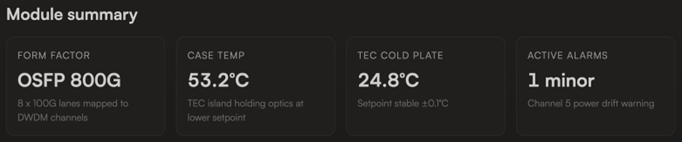
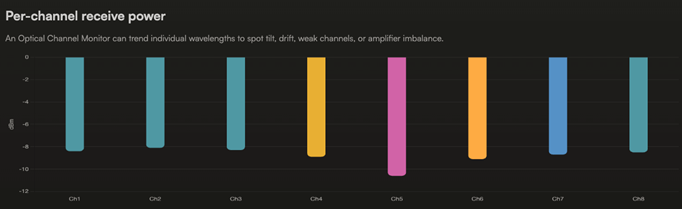
As networks scale to 800G, 1.6T and beyond, design engineers are being asked to accomplish more inside the same pluggable envelope, including monitoring per channel performance in real time. Optical Channel Monitoring (OCM) brings critical visibility into each wavelength's power, alignment, and signal margin, detecting and helping correct issues before they turn into outages.
Instead of relying solely on rack-mounted OCMs at the line system, the industry is increasingly pushing OCM functionality directly into pluggable optical modules such as QSFP, OSFP, and next-generation form factors like eXtra-dense Pluggable Optics (XPO). These “smarter” pluggables are not only expected to transmit bits but also monitor their own optical performance and feed that data to host systems and controllers.
Because pluggables are where most links and most failures occur, embedding OCM there gives granular per-port visibility, faster fault isolation, and real-time optical health data for the automation systems that large-scale AI and cloud data centers depend on. Embedded OCM is becoming a requirement, not a differentiator.
What Integrated OCM in Pluggable Modules Need to Deliver
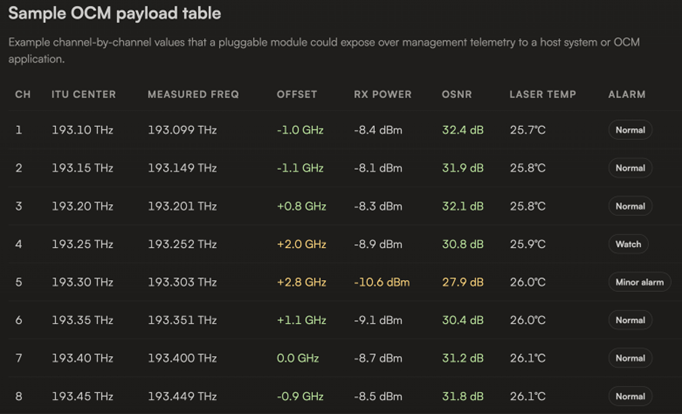
Integrated OCMs must provide actionable visibility in a small footprint at low power:
- per-channel optical power monitoring
- wavelength alignment to the ITU grid
- link health and margin reporting
- telemetry feeds to host systems for closed-loop optimization (power balancing, wavelength tuning, proactive maintenance)
To make this possible within a pluggable module, designers must integrate miniature AWGs (arrayed waveguide gratings) or optical filters for spectral analysis, detector arrays to monitor multiple channels in parallel, and on-board reference lasers or other calibration structures to maintain measurement accuracy over time. Wavelength response, insertion loss, responsivity, dark current, and reference stability are all highly sensitive to temperature. Yet OCM must operate in the same confined space as DSPs, driver ICs, and high-power lasers.
Thermal Reality Inside High‑Speed Pluggables
From a design engineer’s perspective, the design constraints still include:
- Strict host power limits, leaving little headroom for auxiliary functions like OCM and its thermal control
- Limited internal volume and z‑height, which constrains optics, mechanics, and thermal solutions
- Substantial self‑heating from high‑performance DSPs, driver chips, and lasers
- Demanding reliability and lifetime requirements, even as operating temperatures rise.
Within this environment, OCM components are directly impacted by temperature:
- Optical filters and AWGs can drift in wavelength if not stabilized, degrading the accuracy of channel power and wavelength measurements
- Detectors experience higher noise with increasing temperature, limiting sensitivity and degrading the SNR and effective dynamic range
- Reference lasers require a stable temperature to maintain their wavelength accuracy for calibration
Without thermal stabilization, factory calibration tables will not hold in the field, and embedded OCMs cannot deliver the accuracy operators expect from their pluggable optics.
Why Thermoelectric Coolers Are Critical for OCM Accuracy
To maintain consistent OCM functions over the module’s lifetime, critical optical elements must be held at tightly controlled temperatures, often independent of the module’s case or ambient temperature. Thermoelectric coolers (TECs) provide this control by:
- actively pumping heat away from sensitive components such as AWGs, filters, detectors, and reference lasers
- enabling fine temperature setpoints, which stabilize wavelength alignment and detector performance despite varying host and ambient conditions
- delivering this control in compact, solid‑state devices that can be integrated directly into optical subassemblies inside the pluggable
OptoTEC™ MBX Series: TECs Designed for Embedded OCM
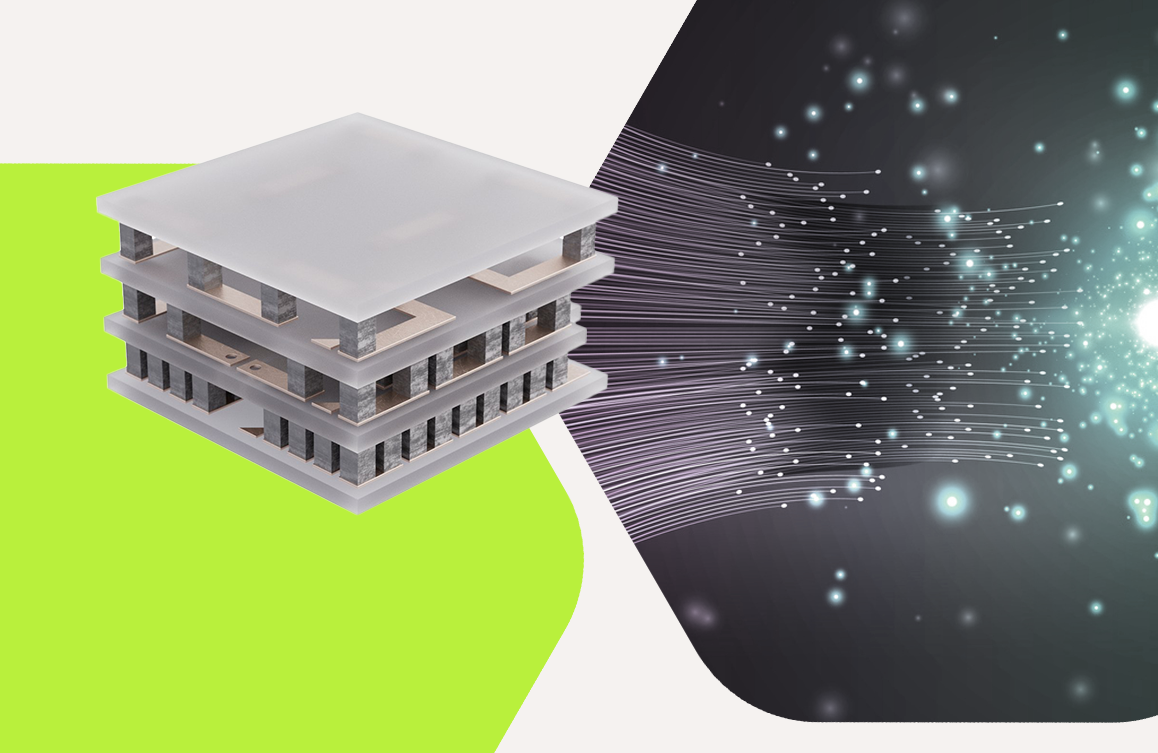
Tark Thermal Solutions’ OptoTEC™ MBX Series TECs are engineered specifically for space‑ and power‑constrained optoelectronic modules. They are commonly used to stabilize OCM subassemblies inside QSFP, OSFP, and next‑generation pluggables.
Key attributes include: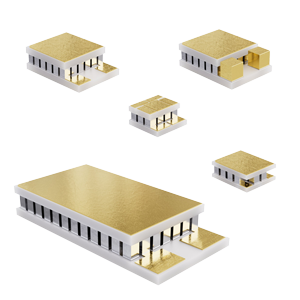
- Ultra‑miniature TECs with footprints as small as ~1.5 × 1.8 mm
- High heat‑pumping density at low input power
- Thin profiles compatible with strict z‑height limits
- Mechanical configurations optimized for direct integration on optical sub‑mounts
- Localized thermal control without requiring a full module re‑layout
Balancing Performance, Power, and Packaging with MBX TECs
As embedded OCM becomes standard in high‑speed pluggables, thermal architecture becomes part of the measurement chain. Without active stabilization, even the best optical designs cannot deliver consistent, field‑reliable OCM data.
OptoTEC MBX Series TECs give module vendors a structured thermal toolbox for embedding OCM directly in the transceiver. MBX TECs handle mainstream OCM elements (AWGs, filters, detector arrays, reference lasers) where good stability at low power is the priority.
Designing OCM into a pluggable module? Contact us to evaluate MBX TECs for your OCM subassembly.
Related Content
