
Optical Transceivers Cooling in the Age of AI Cluster Computers and Data Centers
Introduction Why temperature control matters Thermal Challenges in Optical Transceivers Laser Diode Performance Laser Diode Cooling Challenges Why Ultra-small or Micro TECs? Engineered-to-Order Approach Key Considerations in TEC Design Conclusion
Introduction
High-speed optical transceivers are essential for data communication in modern AI clusters and hyperscale data centers. As transmission speeds push from 400 Gbps toward 1.6 Tbps, thermal management has become a limiting factor in performance and reliability. This article explains the thermal challenges of laser diodes in transceivers and how engineered micro thermoelectric coolers (TECs), such as the OptoTEC™ MBX Series, maintain precise temperature control in compact modules.
Principle of Operation: Why temperature control matters
Optical transceivers convert electrical signals to light using laser diodes that transmit data through fiber. The diode’s wavelength and output power depend on temperature; even minor fluctuations can cause signal degradation or crosstalk in wavelength-division multiplexed (WDM) systems. Maintaining a stable operating temperature improves signal integrity, efficiency, and device longevity.
The recent AI boom has reinvigorated interest in optical transceiver technology, driving innovation and competition in the industry. Optical transceivers are categorized based on their transmission range:
| Type | Range | TECs Used for Cooling |
|---|---|---|
| SR (Short Range) | Hundreds of meters | Typically not |
| DR (Data Center Range) | ~500m - 2km | Typically not |
| FR (Front Range) | ~2km - 10km | Occasionally |
| LR (Long Range) | ~10km - 40km | Yes |
| ZR (Extended Range) | ~40km - 100km | Yes |
As the transmission distance increases, the need for temperature stabilization becomes more critical, leading to the use of thermoelectric coolers (TECs) in longer-range transceivers. Optical transceivers, especially those designed for longer ranges, require precise temperature control to maintain laser stability and performance.
Thermal Challenges in Optical Transceivers
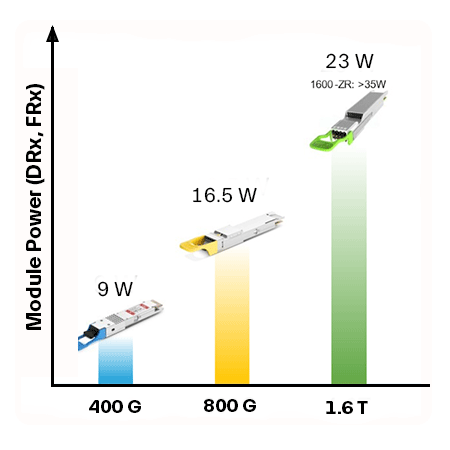
As optical transceiver power density increases with each speed generation (400G, 800G, 1.6T, and beyond), thermal constraints tighten. Multiple lasers, often up to eight, are mounted on a single substrate, each requiring temperature stabilization. Small form factors and tight packaging compound the problem, creating localized hot spots that can exceed component tolerances without active cooling.
Laser diodes are particularly temperature-sensitive:
- High temperatures cause wavelength drift (~0.1 nm/°C), reduced optical power, and shortened lifetime.
- Low temperatures can increase recombination losses and reduce photon life.
- Thermal gradients across an array can create crosstalk in multiplexed systems.
For AI clusters and data centers, consistent temperature control ensures low bit error rates and minimizes power loss in optical interconnects.
Laser Diode Performance
The key component of the optical transceiver responsible for converting electrical signals into light is the laser diode. Although the transceiver itself faces many thermal constraints, it is ultimately the laser diode’s ability to maintain stable performance—within strictly defined temperature ranges—that ensures the overall reliability of high-speed data links. The performance of a laser diode is influenced by many factors, including temperature, current, and optical power. Changes in temperature can cause changes in the electrical and optical properties of the laser diode, which can affect its performance. Operating at elevated temperatures continuously can also shorten the life span of the device.
The operating temperature of a laser varies depending on several factors, such as the type of laser and package, the power of the laser and the operating conditions. Standard lasers designed for telecom applications operate within a specific temperature range either C-temp band between 0 and 75C or I-temp band between -10°C and 85°C, although laser diodes in new optical devices can operate at even higher temperatures. Emerging telecom applications pursuing more than 400 Gb/s feature new optical devices and an expanded maximum temperature range.
At temperatures outside the maximum operating range, the performance of a laser diode can degrade due to increased thermal resistance and reduced current gain. This can result in decreased laser output power and increased threshold current. High temperatures can also shift the wavelength of a laser diode, impacting its performance and reliability. The shift in wavelength is caused by changes in the refractive index of the semiconductor material used in the laser diode. In some cases, a severe shift in wavelength can lead to significant crosstalk (interference), or even failure of the laser. For example, a distributed feedback (DFB) laser diode used in an optical communication application typically emits light at a wavelength of around 1260-1650 nm. An increase in temperature causes a shift in the peak wavelength (toward the long wavelength) of around 0.1 nm/°C.
At lower temperatures, the performance of a laser diode can improve due to reduced thermal resistance and increased current gain. This can result in increased laser output power and reduced threshold current. However, low temperatures outside the minimum operating range can also cause reduced photon life, increased recombination losses, and increased internal losses, which can offset the benefits of reduced thermal resistance.
Another problem attributed to fluctuations in temperature is that of crosstalk. This can be seen in communication links that require high bandwidth and long distances. Hyperscale data centers are an example of this with optical transceivers that use wavelength-division multiplexing to increase data throughput in optical fibers by combining multiple data streams in parallel. (IEEE Transactions on Components, Packaging and Manufacturing Technology, August 2022)
It is important to maintain a stable temperature of a laser diode to maintain a consistent wavelength, eliminating crosstalk and ensuring reliable performance. This can be achieved through temperature control systems that use thermoelectric cooling.
Laser Diode Cooling Challenges
Thermal management of laser diodes is more challenging than ever. More data is being transferred at higher speeds, power densities continue to increase, while product form factors continue to shrink. This inherently results in higher heat flux densities. The need for effective and efficient thermal management solutions is imperative to ensure the proper performance and longevity of laser diodes. In modern high-speed transceivers, multiple lasers (up to eight) may be placed on a single TEC to achieve the desired cooling. For example, an 800G transceiver might use eight lasers, each capable of 100 Gigabits per lane. Tark Thermal Solutions focuses on customizing the thermoelectric element geometry and the number of couples based on the specific operating condition for each transceiver design. This customization allows for incremental improvements in efficiency, which is crucial to reduce overall power consumption in data centers and AI clusters.
Why Ultra-small or Micro TECs?
Advancements in laser diode technology also require advancements in thermal management solutions. As mentioned above, Laser diodes generate more heat as data throughput speeds increase and the distance between connection points increases. As a result, laser diode packages require higher heat pumping capacity to move heat away from sensitive electronics and out of the package. To pump the heat out, micro TECs with higher packing fractions and thinner profiles are required to improve efficiency and maintain precise wavelength control and temperature stabilization.
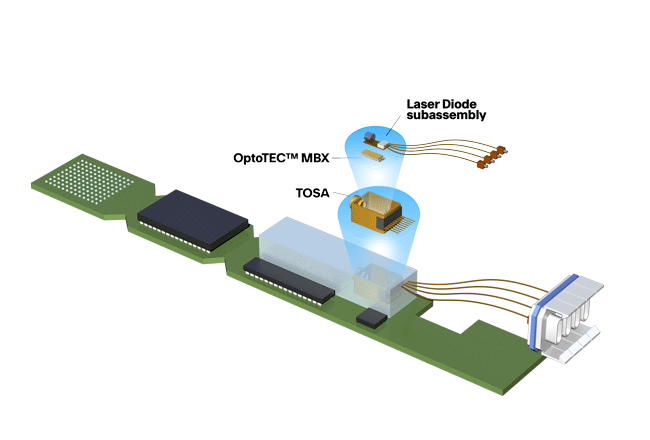
New thermoelectric materials and high-precision manufacturing processes have enabled the development of micro TECs with lower profiles. This allows laser diodes to be made in smaller form factors without compromising thermal stability. They also respond more efficiently to changes in temperature, which is important for applications that require an efficient thermal control response, such as in optical communication systems. Higher efficiency can improve the laser diode performance and reliability enabling higher data transmission rates. In addition, micro TECs can be manufactured inexpensively with high throughput, which can help reduce the overall cost of the laser diode system.
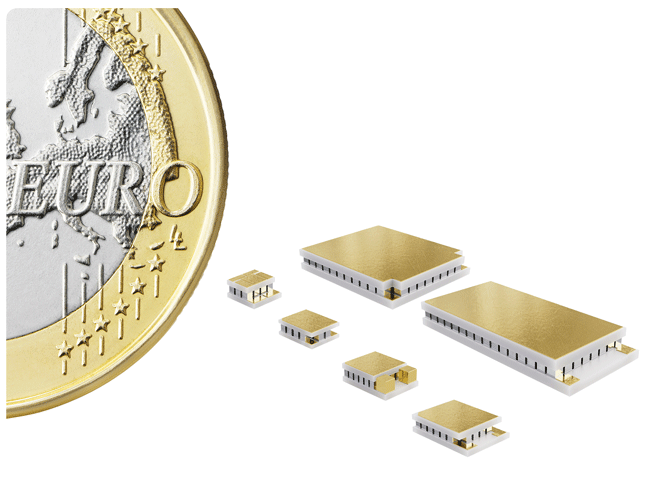
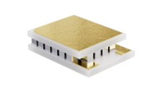
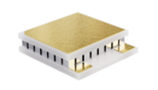
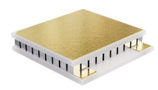
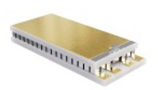
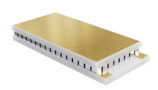
The new OptoTEC™ MBX series from Tark Thermal Solutions is ideal for laser diode temperature stabilization. The ultra-miniature MBX series meets the requirements of modern laser diode applications including smaller size, lower power consumption, higher reliability, and lower cost in mass production. These factors can improve the performance and extend the reliability of the laser diode to enable innovation in next-generation telecom applications.
Engineered-to-Order Approach
As optical transceiver modules evolve—TEC suppliers are designing smaller, thinner, and shape-adaptable modules to fit these tight geometries without sacrificing performance. This includes micro-TECs for on-chip cooling of specific hotspots as an example.
Standard TECs can provide quick design results however top tier applications value engineered-to-order designs to optimize TEC to unique customer operating conditions and feature requirements. Highly customized, engineered-to-order solutions for optical transceiver cooling allow for TEC designs that have the lowest power consumption. The optimization process focuses on customizing the thermoelectric element geometry and number of couples based on the application operating condition of each transceiver design. This customization allows for incremental efficiency improvements, which is crucial for reducing overall power consumption in data centers and AI clusters.
Engineered-to-Order TEC Design
Standard TECs provide general-purpose cooling, but transceiver manufacturers increasingly require engineered-to-order micro TECs optimized for geometry, power budget, and assembly constraints. Design goals include:
- Low power consumption is a priority due to the high density of transceivers in data centers
- Sufficient cooling capacity to handle the typical 1-to-3-watt range for optical transceivers
- Compact form factor to fit within the transceiver module while providing efficient cooling
- High-volume manufacturability for streamlined, scalable fabrication and assembly process to help reduce production costs and improve yield, ensuring TECs can be produced reliably and economically for large-scale deployments.
Application Example: 800Gbps Transceiver TECs
| SR | DR | FR | LR | ZR | |
|---|---|---|---|---|---|
| Laser Type | VCSEL | CW LD | CW LD | EML | ITLA |
| Laser qty | 8 | 4 | 4 | 8 | 1 |
| Heat load | 1.6 W | 2.8 W | 3 W | 2.7 W | 3.5 W |
| Model | MBX20,40,F2N,055039,GG | MBX18,72,F2A,068061,GG | MBX25,59,F2A,062052,GG | MBX18,67,F2A,092040,GG | MBX27,64,F2A,091043,GG |
 |  |  |  |  |
As AI continues to drive the demand for faster and more efficient data transfer, the optical transceiver market is expected to see continued growth and innovation. Customized thermoelectric cooling solutions will play a crucial role in enabling the performance and reliability of these critical components in the rapidly evolving landscape of AI and data center technologies.
Conclusion
The rapid advancement of AI and large language models has created a surge in demand for high-speed optical transceivers, particularly in data centers and AI cluster computers. As AI and data center applications continue to drive demand for faster and more efficient data transfer, the optical transceiver market is poised for continued growth and innovation. Advanced thermoelectric cooling solutions play a crucial role in enabling the performance and reliability of these critical components. By leveraging cutting-edge thermal management techniques, and optimized TEC designs, Tark Thermal Solutions' customized thermoelectric cooling solutions play a crucial role in enabling the performance and reliability of these critical components.
By offering highly engineered, efficient cooling solutions with quick turnaround times, Tark Thermal Solutions continues to be at the forefront of this dynamic and growing market. As the industry pushes towards even higher data transfer rates and greater power efficiency, the company's expertise in thermal management will remain a key enabler of next-generation optical transceiver technology.
FAQ
What causes wavelength drift in laser diodes?
Changes in temperature alter the refractive index of the semiconductor, shifting the emission wavelength by roughly 0.1 nm per °C.
Why are TECs used mainly in long-range transceivers?
Short-range modules typically operate in controlled environments with low heat density. Long-range and high-speed modules require strict wavelength stability over wide temperature ranges.
How much power do TECs in optical transceivers consume?
Typical cooling loads are 1–3 W, but overall system power depends on transceiver design and duty cycle.
Can one TEC cool multiple lasers?
Yes. In high-density transceivers, a single TEC may stabilize up to eight laser diodes, balancing power and efficiency.
What advantages do micro TECs provide over standard TECs?
They enable tighter thermal control in smaller packages, improve efficiency, and support high-volume production for telecom-grade reliability.
How does TEC customization improve efficiency?
Optimizing thermoelectric element geometry and couple count minimizes electrical losses and heat leakage, reducing total power consumption.
More information on the OptoTEC™ MBX Series can be found by visiting
https://tark-solutions.com/products/thermoelectric-cooler-modules/micro-MBX-series