Thermoelectric Cooling for MCUs: Reliable Thermal Control in Modern Vehicles
Key Facts
- Automotive MCUs manage critical vehicle functions, including powertrain control, safety monitoring, chassis systems, comfort features, and advanced driver assistance.
- Automotive-grade MCUs commonly operate across wide temperature ranges, typically from −40 °C to 85 °C. Some specialized automotive applications may require higher temperature capability.
- Thermoelectric coolers provide compact, solid-state spot cooling for localized hotspots in automotive electronics.
- The Tark Thermal Solutions HiTemp ETX Series offers heat pumping capacities from 8 to 321 Watts and a maximum temperature differential of 83 °C.
- TECs are especially relevant where precise temperature control, compact integration, vibration resistance, and long operating life are required.
Introduction
Thermal management has become a critical design priority in modern vehicles. As electronic content increases in both conventional vehicles and electric vehicles, Main Control Units, or MCUs, must manage more processing, power coordination, diagnostics, and safety-critical control functions.
An MCU coordinates key vehicle systems and helps ensure stable, reliable operation across changing electrical, thermal, and environmental conditions. As vehicles become more software-defined, MCU thermal loads continue to rise, making precise temperature control essential for long-term reliability.
What Is an Automotive MCU?
An automotive Main Control Unit is an electronic control system that manages and coordinates important vehicle functions. It may control powertrain behavior, monitor safety conditions, coordinate vehicle-level systems, and process data for advanced driver assistance features.
Automotive MCUs can support functions such as: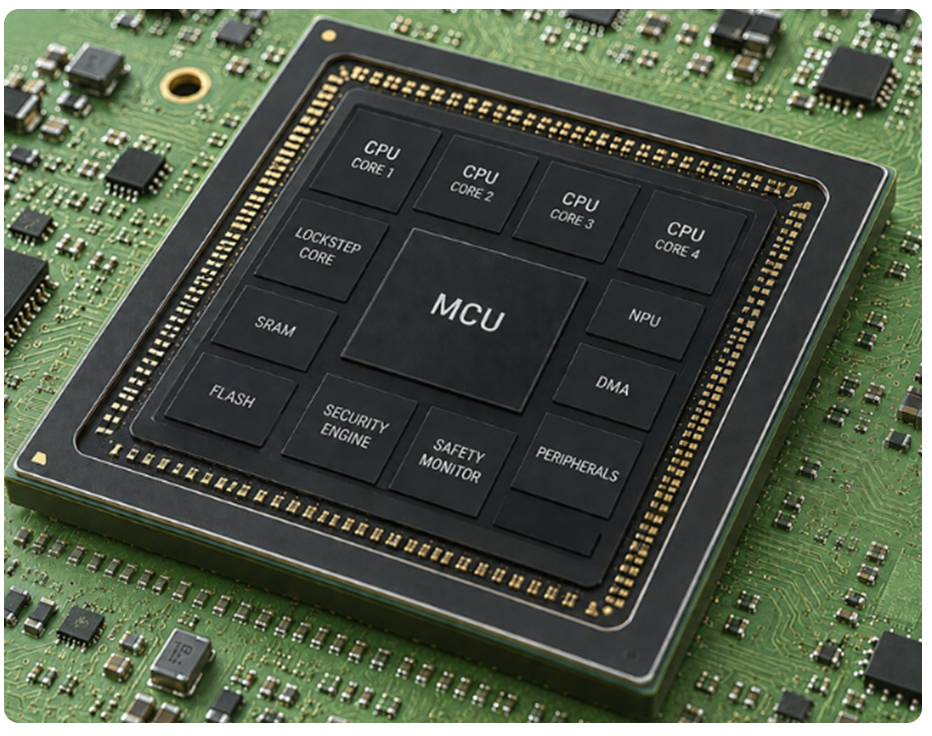
- Powertrain and motor control, including motor torque and speed
- Safety and fault management, including monitoring of motor and inverter voltage, current, and temperature
- Vehicle-level coordination, including feedback for traction and stability control
- Body, chassis, and comfort systems, including HVAC fans, lighting, door locks, windows, wipers, and seat controls
- Advanced autonomous and driver-assistance functions, including sensor input processing and decision coordination
In electric vehicles, MCUs also interact with systems linked to batteries, power electronics, charging functions, and advanced software features. Keeping these electronics within their intended operating temperature range is essential for performance, safety, and service life.
Why MCU Thermal Management Matters in Vehicles
Automotive electronics operate in harsh environments. In internal combustion engine vehicles, MCUs may be exposed to high under-hood temperatures, ambient heat soak, vibration, and tight packaging constraints.
Electric vehicles remove some traditional engine-related heat sources, but they introduce new thermal challenges. Batteries, inverters, onboard chargers, and power electronic systems all depend on tightly controlled temperatures to preserve efficiency, reliability, and performance.
As vehicle architecture becomes more connected and software-defined, MCU processing loads increase. Connectivity, diagnostics, energy management, driver assistance, and automated driving functions can create localized hotspots that require careful management.
Typical Automotive MCU Temperature Ranges
Automotive-grade MCUs are designed for wide operating temperature ranges. Many devices operate from approximately −40 °C to 85 °C. Some specialized systems, such as high-performance lighting, under-hood electronics, or electronics placed near localized heat sources, may require higher temperature tolerance.
How Thermoelectric Cooling Supports MCU Reliability
Thermoelectric coolers, or TECs, are solid-state cooling devices that move heat from one side of the module to the other when electrical current is applied. For automotive MCUs, TECs can provide localized cooling near specific heat-generating components rather than cooling an entire enclosure.
Thermoelectric cooling is not required for every automotive MCU. Lower-power chipsets often operate reliably with passive heat spreading, heat sinks, airflow, or fan-assisted cooling, while higher-power processors used for intelligent driving and advanced compute workloads may require liquid cooling to manage significantly higher heat loads.
TECs are most relevant when engineers need localized, precise temperature control near processors, sensors, or control electronics that experience peak thermal loads or operate in harsh thermal environments. This spot-cooling approach is valuable when only one processor, sensor, or control component requires additional thermal support, or when enclosure space is limited and conventional cooling methods are difficult to integrate.
TECs can be adjusted by varying input current. This allows engineers to tune cooling performance in response to changing operating conditions, offering more precise thermal control than passive-only solutions.
Where TECs Fit in Automotive Electronics
Thermoelectric coolers are especially relevant for automotive systems that require compact, targeted, and responsive cooling. In addition to MCU-related electronics, TECs can support localized thermal control for infotainment processors, connected cockpit platforms, 5G communication chipsets, and Wi-Fi modules.
Potential application areas include control electronics for:
- Infotainment and connected cockpit systems
- 5G communication modules
- Wi-Fi connectivity modules
- 360-degree camera image processing
- Traffic sign recognition
- Pedestrian detection
- Collision avoidance warning
- Light, object, and lane detection
- Map-based assistance systems
- Autonomous and semi-autonomous driving functions
In these systems, temperature stability can directly influence signal quality, processing reliability, and long-term component performance.
Advantages of Thermoelectric Cooling for Automotive MCUs
TECs offer several advantages for automotive applications. They are compact, quiet, and capable of precise temperature control, making them suitable for localized cooling inside dense electronic assemblies.
Because TECs contain no moving parts, they also provide durability benefits in vehicle environments where vibration, dust, and long operating life are important. This solid-state design can reduce dependence on mechanical cooling components and improve overall system robustness.
Key advantages include:
- Compact integration near heat-generating components
- Solid-state operation with no moving parts
- Precise temperature control through current adjustment
- Quiet operation
- Targeted spot cooling for localized hotspots
- Suitability for harsh automotive environments
Design Considerations for TEC Integration
Thermoelectric coolers are not a one-size-fits-all solution. Their efficiency is generally lower than that of large conventional refrigeration systems, so engineers must balance TEC power consumption against the thermal benefit provided.
This trade-off is especially important in electric vehicles, where energy use can influence overall system efficiency and driving range. For this reason, TECs are often most effective as part of a hybrid thermal architecture.
A vehicle system may use passive heat spreading, heat sinks, or liquid cooling for baseline thermal control. A TEC can then provide precision cooling during peak loads or under harsh operating conditions.
Heat Rejection Requirements
A TEC does not eliminate heat. It transfers heat from the cold side of the module to the hot side.
This means the system still needs an effective heat rejection path. Depending on the application, the hot side of the TEC may require a heat sink, fan, liquid-based exchanger, or another thermal interface to dissipate heat into the surrounding environment.
Effective heat rejection is essential for stable TEC performance and reliable MCU cooling.
HiTemp ETX Series for High-Temperature Automotive Applications
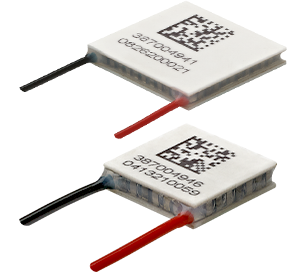 For automotive design engineers evaluating high-temperature thermoelectric options, the Tark Thermal Solutions HiTemp ETX Series provides a compact, solid-state cooling solution for demanding environments.
The HiTemp ETX Series is built with advanced thermoelectric materials and a higher thermal insulating barrier. It is designed to prevent performance degradation in high-temperature environments and provides a maximum temperature differential of 83 °C.
The series offers package sizes down to 0.472 × 0.472 × 0.081 inches, making it relevant for compact vehicle electronics where space is limited and thermal conditions can be severe.
With heat pumping capacities from 8 to 321 Watts, the HiTemp ETX Series supports high-temperature applications linked to autonomous systems, ADAS-style optical and imaging electronics, and other performance-sensitive automotive components.
How HiTemp ETX Supports MCU-Related Designs
For MCU-related automotive designs, the HiTemp ETX Series can be positioned as a specialized option for localized thermal control. It is suitable where engineers need compact, solid-state cooling near sensitive processors, sensors, or control electronics.
Rather than replacing the complete vehicle thermal architecture, a thermoelectric module can complement existing cooling methods. This makes it a practical option for hotspot control, peak-load cooling, and temperature stabilization in compact electronic assemblies.
Why Thermoelectric Cooling Is Becoming More Relevant
Automotive electronics are becoming more complex, compact, and performance-driven. As a result, demand is growing for cooling solutions that are precise, adaptable, and reliable.
Thermoelectric coolers offer a compelling approach for MCUs and related control hardware because they combine compact form factors, responsive control, and rugged solid-state operation. In conventional vehicles and EVs, TECs are becoming increasingly