Compact Temperature Control for Medical Diagnostic and Analytical Instrumentation
Summary: Medical diagnostic and analytical instruments keep shrinking, which forces more waste heat into less space. Thermoelectric cooler assemblies (TEAs), compact, solid-state, refrigerant-free heat pumps, solve the problem. Tark Thermal Solutions' boosted Tunnel Series to deliver over 100 W of cooling in a small form factor, and when paired with the SR-54 temperature controller, they hold a set point to within ±1 °C. Typical uses: immunoassay analyzers, clinical chemistry analyzers, centrifuges, benchtop incubators, and liquid chromatography.
The Problem: Miniaturization Creates Thermal Challenges
Lab bench space is tight, so OEMs keep packing more functionality into smaller instruments. This increases the heat flux by packing electronics in a smaller footprint and has led to thermal challenges. Waste heat must be efficiently managed to meet conflicting requirements:
- Higher performance per instrument
- Lower power consumption
- Quieter operation
All of it inside a smaller chassis. A bigger fan and heat sink can't bridge that gap.
For instruments that need specific reaction temperatures, benchtop incubators, laboratory centrifuges, chromatography systems, and clinical chemistry analyzers, the cooling subsystem is no longer just a thermal afterthought. It directly affects footprint, power budget, and test accuracy.
Thermal Management Techniques
Two categories cover most solutions:
- Passive cooling moves heat by conduction and convection alone, such as heat sinks, fans, and thermal interface materials. It can only cool to ambient, so it works when the ambient is already cold enough.
- Active cooling uses a heat pump to cool below ambient. The two options are vapor-compression (traditional refrigeration) and thermoelectric (solid-state, based on the Peltier effect).
Where Precise Temperature Control Matters
Automated blood analyzers and centrifuges. Used in healthcare, forensic, and bioscience labs. Cold temperatures extend reagent life. Historically, these ran on compressors or recirculating chillers; modern systems are shifting to thermoelectrics for better performance in a smaller envelope.
Immunoassay and clinical chemistry analyzers. Hospital and central labs use these to diagnose and monitor disease and to run drug testing. They quantify substances in patient fluid samples — glucose, cholesterol, proteins, enzymes — using chemical reactions and measurement techniques like photometry, colorimetry, and potentiometry. Immunoassay variants specifically measure concentration via antibody-antigen reactions. Both types rely on reagents stored on board. To extend shelf life, reagent chambers are typically held at 4 °C to 8 °C. TECAs are a direct replacement for the compressor systems that used to do this job.
Liquid chromatography (LC / HPLC). Used in pharmaceutical, food science, and oil & gas R&D for separating, identifying, and quantifying the components of a mixture. Thermoelectrics show up in two places inside high-performance liquid chromatography (HPLC) instruments:
- Temperature control of the sample storage compartment (cooling and heating)
- Heating and cooling of the separation column
Typical control range is 4 °C to 40 °C, depending on the mixture. Heat loads run 20 W to 100 W; however, newer high-throughput HPLC machines can require up to 200 W. Multiple independently controlled sample chambers are increasingly common, pushing the total system heat load higher.
The Solution: Tark Thermal Solutions' Boosted Tunnel Series TEAs
A thermoelectric cooler assembly combines a Peltier module with heat exchangers, fans, and ducting. Apply DC current and one side gets cold while the other rejects heat: no refrigerant, no compressor, no moving parts besides the fan.
Tark Thermal Solutions has expanded the Tunnel Series to cover the higher-capacity end of this range. Earlier Tunnel Series assemblies topped out at 30+ W; the boosted Tunnel Series now exceeds 100 W, enough for larger reagent chambers and storage compartments.
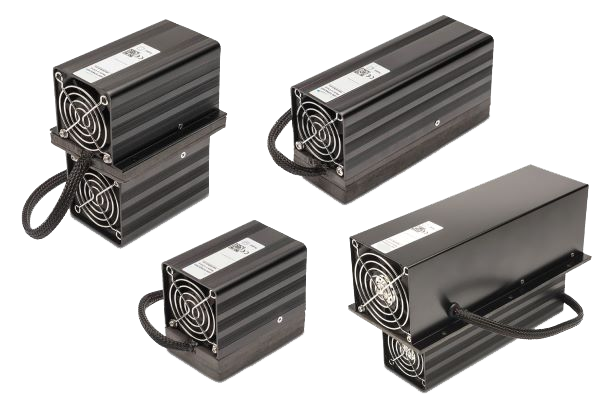
The space-saving Tunnel Series thermoelectric cooler assemblies offer compact cooling performance for analytical and medical instrumentation.
Tunnel Series specifications
- Cooling capacity: over 100 W (boosted configuration)
- Input voltage: 12 V or 24 V DC
- Heat transfer options: air-to-air or direct-to-air
- Airflow design: moves air across heat sinks rather than using traditional impingement flow, which reduces the number of airflow paths the chassis has to accommodate — important when space is tight
- Thermoelectric modules: optimized for high efficiency and improved reliability
- Build features: lower-noise fans, improved sealing against moisture intrusion, higher overall efficiency than traditional TECAs
The cross-flow airflow design is what makes the small form factor possible. Fewer airflow paths means more freedom in where and how the assembly fits inside the instrument.
Precise Temperature Control: the PR 59 Temperature Controller
Paired with an advanced PR-59 Series temperature controller, the assembly offers temperature control to within +/- 1 °C. The controller requires minimal programming and can be easily adhered to a thermoelectric cooler assembly or system enclosure.
Controllers such as the PR-59 are designed to manage these systems by providing accurate, bidirectional temperature regulation using configurable control methods (e.g., PID, ON/OFF, or power control). They enable real-time monitoring and adjustment of temperature parameters, ensuring high stability (±0.05°C) and fine resolution down to 0.01°C, which is critical in applications such as medical diagnostics, analytical instrumentation, and photonics systems. With support for multiple sensor types (e.g., NTC or PT1000), programmable setpoints, and integrated outputs for thermoelectric modules, fans, and alarms, these controllers allow TEAs to operate as fully integrated, standalone thermal management solutions across a wide operating range (typically -20°C to +100°C).
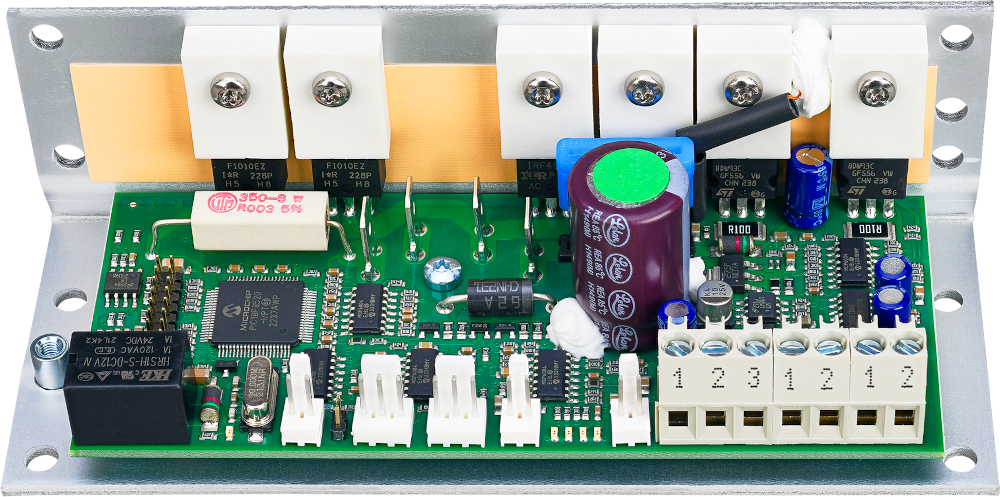
Tark Thermal Solutions’ PR-59 Series temperature controller
Why TEAs over compressors in this class of instrument
- Compact — much smaller for the cooling loads these instruments actually need
- Solid-state — no moving parts beyond the fans, so fewer wear items
- No refrigerants — no F-gas regulatory exposure
- Mount in any orientation — layout flexibility inside the chassis
- Precise control — better set-point stability in both cooling and heating
- Faster temperature ramp rates
- Lower noise
- Higher reliability / longer MTBF (mean time between failures)
Specs at a glance
| Parameter | Boosted Tunnel Series + PR-59 |
|---|---|
| Cooling capacity | 100+ W |
| Input voltage | 12 V or 24 V DC |
| Temperature control accuracy | ±1 °C |
| Heat transfer modes | Air-to-air, direct-to-air |
| Refrigerant | None (solid-state Peltier) |
| Control mode | Bidirectional (cooling and heating) |
| Fault monitoring | Fan, over-temperature thermostat, temperature sensor |
| Typical reagent chamber set point | 4–8 °C |
| Typical HPLC control range | 4–40 °C |
Conclusion
Cooling below ambient is essential for immunoassay analyzers, clinical chemistry analyzers, centrifuges, and HPLC systems. Even small temperature swings skew test results and shorten reagent and sample life. Tark Thermal Solutions' boosted Tunnel Series TEAs plus the PR-59 controller deliver the stability, condensation protection, compactness, and reliability these instruments need, all in a footprint designed for the space constraints of modern lab equipment.
FAQ
What is a thermoelectric cooler assembly? A solid-state heat pump (using the Peltier effect) combined with heat exchangers, fans, and shrouds. It moves heat from one side to another when DC current is applied — no refrigerant, no compressor.
How much cooling does the boosted Tunnel Series provide? Over 100 W, compared to 30+ W for the earlier Tunnel Series generation.
What voltages does it support? 12 V and 24 V DC.
How accurate is the temperature control? Within ±1 °C of the set point when the TECA is paired with the SR-54 Series temperature controller.
Can it heat as well as cool? Yes. The SR-54 is bidirectional, so the same assembly handles heating and cooling depending on the set point.
What does the SR-54 monitor for faults? Fan problems, over-temperature thermostat events, and temperature sensor failures. Any of these triggers an alarm.
Why use thermoelectrics instead of a compressor? Smaller footprint, no refrigerants, no moving parts besides the fans, any-orientation mounting, faster ramp rates, lower noise, and better set-point stability for the cooling loads these instruments need. Compressors still win on raw efficiency at very high cooling loads — but diagnostic and analytical instruments usually sit well inside the TECA sweet spot.
What instruments typically use this configuration? Automated blood analyzers, laboratory centrifuges, benchtop incubators, immunoassay analyzers, clinical chemistry analyzers, and HPLC / liquid chromatography systems — particularly their sample storage compartments and separation columns.
What temperature range does HPLC typically need? Between 4 °C and 40 °C, with heat loads of 20–100 W (up to 200 W in newer high-throughput machines).
What temperature do reagent chambers run at? Typically held constant between 4 °C and 8 °C to extend reagent shelf life.