
Ultra-Compact Coolers for Next-Generation Optical Transceivers
How ultra-miniature TECs stabilize wavelength, reduce crosstalk, and extend device lifetime
Telecom and datacom systems increasingly rely on high-speed optical links, coherent signaling, and dense wavelength-division multiplexing. As data rates push well beyond 400 Gb/s, the thermal load on laser diodes grows while optical module sizes shrink. Modern laser diode packages require precise, fast-response temperature control to maintain wavelength stability, minimize crosstalk, and protect device longevity.
The OptoTEC™ MBX Series of micro thermoelectric coolers provides the high heat-flux capability, compact geometry, and low-power operation needed for next-generation optical transceivers and optical sub-assemblies. In this application note, we will discuss laser diodes commonly used in telecom applications, and how ultra-small thermoelectric coolers (Micro TECs) can remove the heat generated in the laser diode package to optimize overall performance.

Micro thermoelectric coolers remove the heat generated
in the laser diode package to optimize overall performance
Technology Snapshot
Laser diodes provide the optical source in fiber-optic communication systems. The narrow, high-speed beam couples efficiently into fiber and maintains signal integrity over long distances. Unlike other types of lasers that use gas or liquid as the active medium, laser diodes use a solid-state material such as gallium arsenide (GaAs) or indium gallium arsenide (InGaAs). Their compact size and low electrical power requirements make them standard in telecom and datacom optical links.
However, laser diode performance is highly temperature-dependent:
• Wavelength shifts ~0.1 nm/°C for typical DFB lasers.
• Threshold current increases with temperature.
• Excess heat accelerates aging and reduces lifetime.
• Thermal drift contributes to optical crosstalk in WDM systems.
Micro thermoelectric coolers (TECs) provide closed-loop control of the laser diode’s junction temperature, enabling stable operation across wide environmental ranges.
Where Laser Diodes Are Used in Telecom and Datacom
Laser diodes appear in most optical communication components:
• Pluggable optical transceivers (QSFP, OSFP, CFP)
• Wavelength-division multiplexing (WDM) modules
• Optical amplifiers including EDFA pump lasers
• LIDAR and 3D sensing
• Data center interconnects
• Long-haul coherent optical systems
According to market research, the global laser diode market continues to grow rapidly due to AI/ML infrastructure, hyperscale data centers, and 5G/6G expansion.
Types of Laser Diodes Used in Telecom and Datacom
Different laser architectures support different data rates, wavelengths, and modulation formats.
Laser Type | Typical Use | Notes |
|---|---|---|
Fabry-Perot (FP) | General fiber-optic transmission | Broad linewidth; cost-effective |
Distributed Feedback (DFB) | DWDM systems | Narrow, stable wavelength; sensitive to thermal drift |
VCSEL | Data center links | Low-cost, high-speed surface emitters |
Coherent-grade lasers | Coherent optics for ML/AI backbones | Require extremely stable temperature |
Pump lasers | EDFAs in subsea and long-haul networks | High reliability and high power |
Laser Diode Packaging and Thermal Constraints
Common laser packages include:
- Butterfly packages (14-pin)
- TO-can packages
- TOSA / ROSA / BOSA optical sub-assemblies
- Pigtailed packages
- MSA-compliant pluggable modules
As optical modules shrink to support higher port densities, heat flux density increases. Small enclosures reduce available conduction paths and restrict airflow, making passive cooling insufficient for wavelength-critical applications.
How Temperature Affects Laser Diode Performance
Laser diodes used in telecom typically operate between −10 °C and 85 °C, with next-generation devices supporting even wider ranges. At temperatures outside the maximum operating range, the performance of a laser diode can degrade due to increased thermal resistance and reduced current gain. This can result in decreased laser output power and increased threshold current.
Another problem attributed to temperature fluctuations is crosstalk. This can be seen in communication links that require high bandwidth and long distances. Hyperscale data centers are an example of this, with optical transceivers that use wavelength-division multiplexing to increase data throughput by combining multiple data streams in parallel.
Temperature impacts:
- Wavelength stability — drift causes WDM crosstalk.
- Output power — higher temperature reduces power efficiency.
- Threshold current — rises sharply with temperature.
- Device lifetime — heat accelerates degradation of active layers.
For example, a DFB laser at 1310–1650 nm shifts ~0.1 nm per °C. Even small fluctuations disrupt multi-channel optical networks. At lower temperatures, the performance of a laser diode can
improve due to reduced thermal resistance and increased current gain. This can result in
increased laser output power and reduced threshold current.
Why Telecom Systems Need Micro TECs
Thermal management of laser diodes is more challenging than ever. More data is being transferred at higher speeds, power densities continue to increase, and product form factors continue to shrink. This inherently results in higher heat flux densities. The need for effective and efficient thermal management solutions isimperative to ensure proper performance and longevity of laser diodes. Micro TECs enable precise temperature stabilization in extremely small optical packages.
Benefits of ultra-miniature TECs
- Higher packing fractions → high heat pumping densities up to 43 W/cm2 at lower operating currents than traditional TECs.
- Thin profiles → fit inside compact optical sub-assemblies and pluggable transceivers as small as 1.5x1.1mm with thicknesses down to 0.65mm.
- Fast thermal response → reduced wavelength drift
- Low power consumption → lower load on the module’s power budget
- Manufacturable at scale → cost-effective for high-volume telecom components
As data rates climb and transceiver modules move to OSFP-X and other ultra-dense formats, MBX-class micro TECs become essential to keep the laser wavelength locked under dynamic thermal loads.
OptoTEC™ MBX Series Overview (Product-Relevant Section)
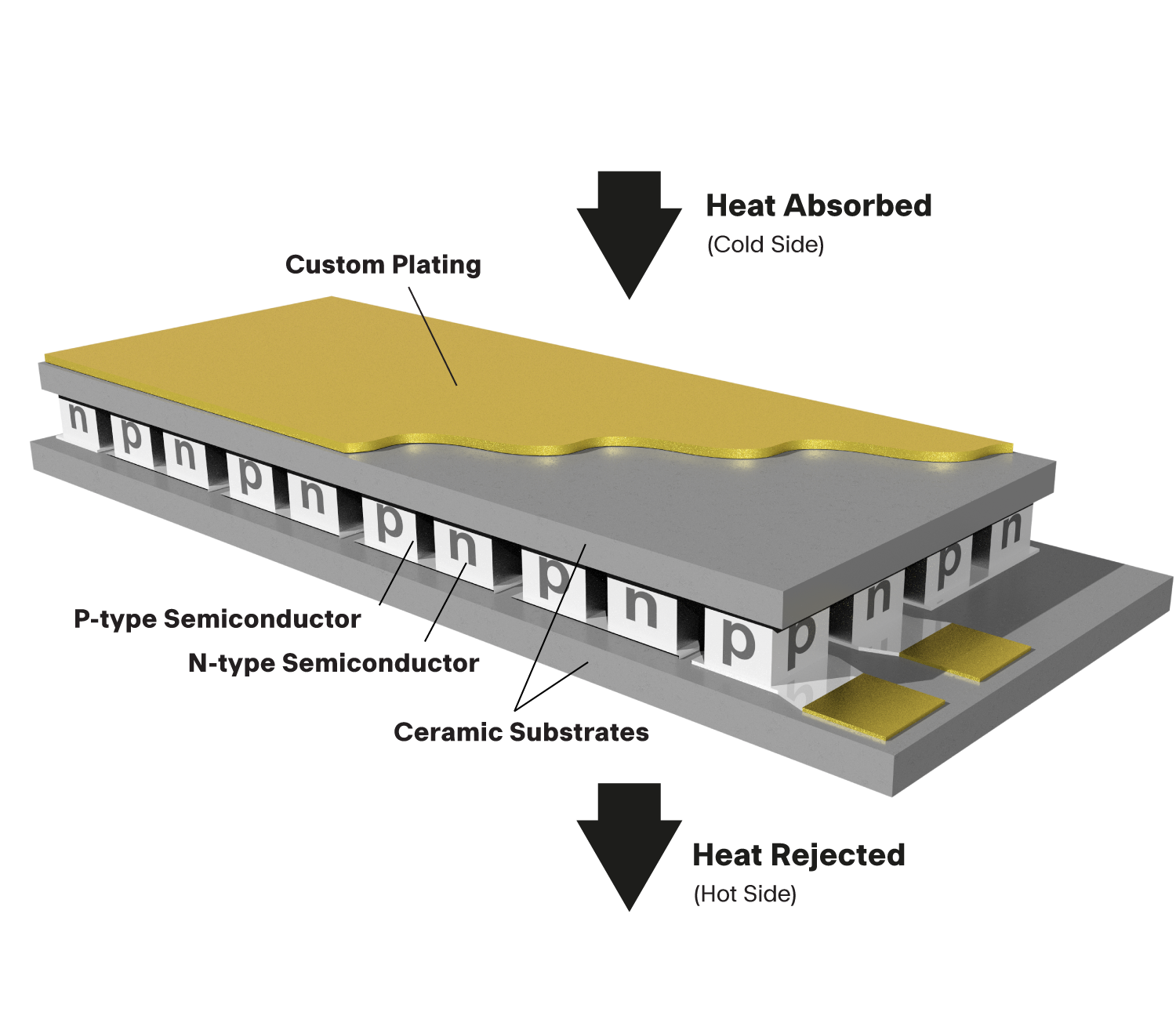
The OptoTEC™ MBX Series is engineered specifically for high-temperature, constrained-geometry telecom applications. MBX TECs maintain diode temperature stability inside small optical sub-assemblies where space, efficiency, and thermal responsiveness are all constrained.
Key Characteristics:
- Micro footprints as small as 1.5 × 1.1 mm
- Profiles down to 0.65 mm
- Heat pumping density up to 43 W/cm²
- Lower operating current than conventional TECs
- Supports high-temperature solder construction (SnSb 232 °C or AuSn 280 °C)
- Available with Alumina (Al₂O₃) or Aluminum Nitride (AlN) ceramics
- Options for gold plating, metallization, pre-tinning, thermistors, and hermetic sealing
Implementation
Temperature stabilization is a key challenge in the field. For example, the typical operating temperature range for a laser diode is between 25°C and 85°C. If housed in an 85°C environment, then cooled to 25°C, the device will almost reach maximum performance at a 60°C temperature differential with minimal heat pumping capacity. While these applications need cooling, the heat removal required must be done efficiently through low thermal resistance heat conduction paths in the package. The following design considerations below should be evaluated to remove heat efficiently:
- Optimized TEC Design: application requirements need to be thoroughly understood at the desired operating point. The geometry factor and number of couples can be optimized to match heat removal requirements from the laser diode plus passive heat losses. Thermal resistances of the hot and cold side need to be accounted for as they will reduce temperature differential across the thermoelectric cooler quite a bit
- Package Design: the least expensive package in the smallest form factor is often chosen. However, the package is the key heat dissipation mechanism, and may not have the best thermal conductivity. As the form factor of the package shrinks, the heat flux density increases and poor heat dissipation can lead to thermal runaway. This can be avoided by sizing the package and thermal conductivity of the material to accommodate total heat rejection required from the TEC and laser diode
- Interface between TEC and package: the solderability of the TEC to the package is critical to assure proper heat rejection from the TEC. Poor solder adhesion leads to solder voiding and this increases the hot side thermal resistance. Proper plating materials need to be specified on ceramic substrate surfaces of the TEC in combination with optimal solder to assure a thin bond layer is achieved with minimal solder voiding. This will have maximum impact by increasing efficiency of the TEC in operation
- Parasitic Losses: passive heat losses can occur from a thermal short between the hot and cold side of the TEC. Most packages are hermetically sealed in vacuum or gas, so this minimizes thermal losses from passive heat in the surrounding environment. However, lead attachments to the TEC and optical devices on the cold side substrate of the TEC are susceptible to heat transfer from the hot side. This will cause the TEC to consume more input power to achieve the same cooling power required. It is ideal to design the TEC to operate at a lower current since this will reduce the gauge thickness of the lead wire and reduce heat transfer from the lead wires
Once main design variables have been determined, the TEC is controlled by a temperature control circuit, which adjusts the current supplied to the TEC to maintain the laser diode at the desired control temperature. Other variables to consider are substrate materials and solder construction of the TEC. Materials exist with higher thermal conductivity and solder adhesion, which boost performance, heat spreading and reliability, but they must be weighed against cost targets of the end user application. Most applications cannot support higher material costs in high volume.
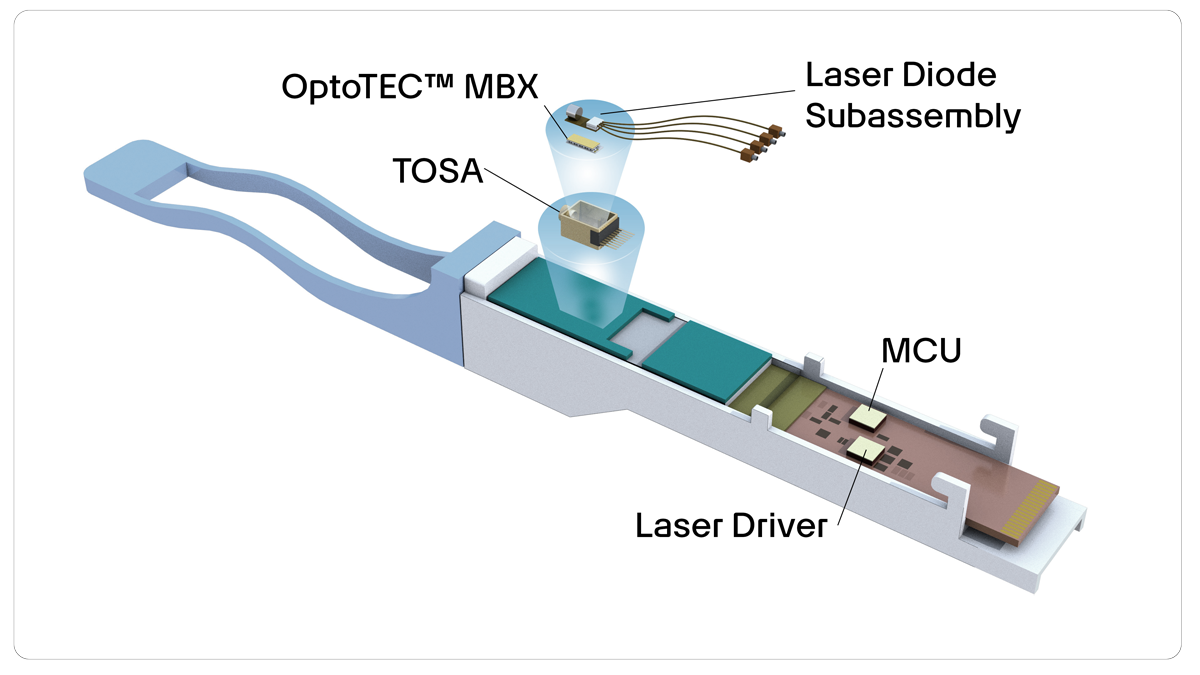
Optical Transceiver Laser Diode Cooling
Conclusion
Optical communication has been one of the driving forces in developing laser diode technology. Laser diodes play an important role in ensuring the reliability and stability of these systems. However, temperature fluctuations can affect the performance of a laser diode, and it is important to maintain a stable temperature to ensure consistent and reliable performance. High temperatures can degrade performance, while lower temperatures can improve performance, but also have potential drawbacks including reduced photon life. By employing micro TECs inside laser diode packages, laser diode performance and operating lifetime can be optimized. TECs are an ideal technology for cooling laser diodes because they provide high cooling power, fast response time, compact size, energy efficiency, low energy consumption and ease of temperature control.
For more information on the OptoTEC™ MBX Series CLICK HERE
Downloads
Applications
Product Section
Related Products
