
Optical Transceiver Cooling
Precise Temperature Stabilization for 400G, 800G, 1.6T and Next-Generation Optical Modules
Optical transceivers enable high-speed data transfer in telecom networks, hyperscale data centers, AI clusters, and 5G/6G infrastructure by converting electrical signals to optical signals (and back) over fiber.
As speeds move from 400G to 800G, 1.6T, and beyond, thermal stability becomes a performance limiter. Even small temperature shifts can impact laser wavelength stability, output power, signal integrity, and reliability, making active thermal management essential for next-generation pluggables.

Active Cooling Solutions for Optical Transceivers
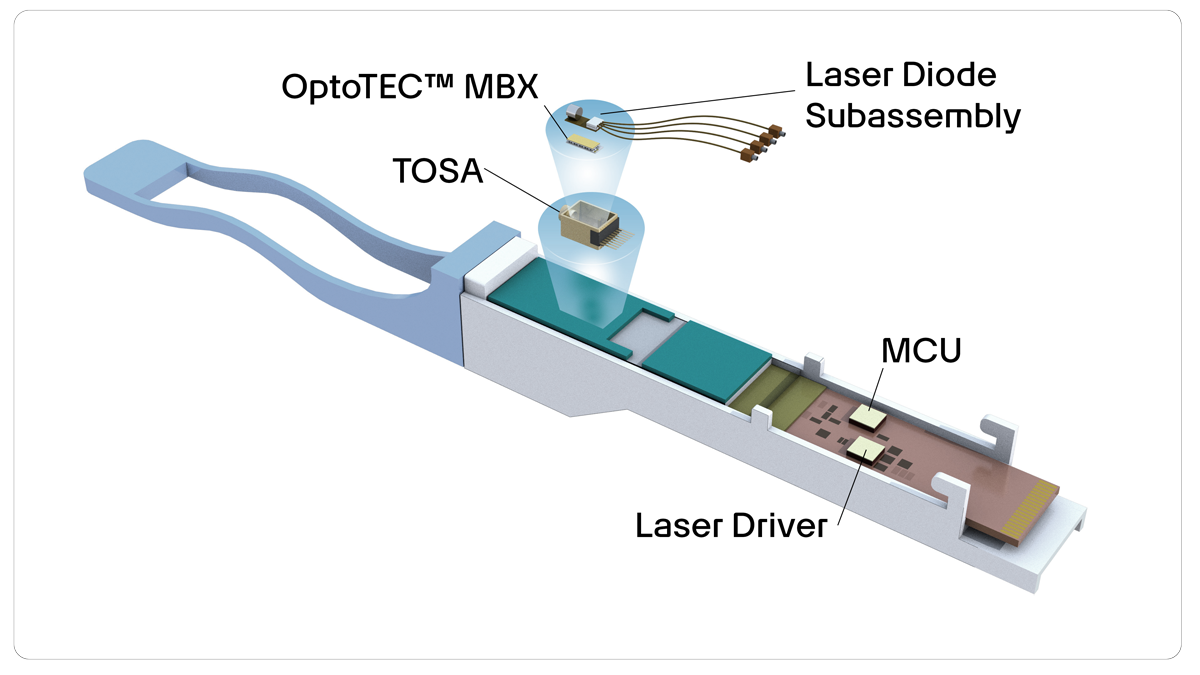
We support optical module and subsystem designers with miniature thermoelectric coolers (TECs) engineered for tight form factors and demanding environments. TECs provide bi-directional control (cooling + heating) for precise temperature regulation, helping maintain stable laser performance even when ambient conditions or data rates change.
Product families used in optical and high-temperature optoelectronics:
- OptoTEC™ MBX Series (micro TECs, ultra-compact footprints for pluggables and tight optical packages)
- OptoTEC™ MSX Series (micro multistage TEC performance for deeper ΔT requirements in compact space)
- OptoTEC™ OTX/HTX Series (miniature TECs for temperature stabilization of optoelectronics, including higher-temp requirements)
Tell us your package type (QSFP/OSFP, Butterfly, TOSA/ROSA) and your temperature targets, and our team can recommend the best TEC configuration.
Common Laser Types in Fiber-Optic Transmitters
Semiconductor lasers are the core light source in optical transmitters. Typical laser types include:
- Fabry–Pérot (FP): Often used for cost-sensitive links and shorter distances.
- Distributed Feedback (DFB): Narrow spectral linewidth and stable wavelength, commonly used in DWDM and longer-reach applications.
- VCSEL: Cost-effective, high-speed performance for short-reach links and many data center interconnect applications.
Selecting a laser diode depends on reach, data rate, wavelength, bandwidth, power budget, efficiency, and reliability targets
Why Temperature Stabilization Matters in Optical Transceivers
Temperature directly affects:
- Laser wavelength drift (critical for DWDM and coherent optics)
- Output power and modulation behavior
- Receiver sensitivity/signal margin
- Module lifetime and field reliability
There are multiple approaches to laser temperature control (link to your application note). In compact transceiver formats, TECs are often ideal because they enable both cooling and heating with fast response, supporting precise setpoint control across changing environmental conditions.
Common Optical Transceiver & Laser Packaging Formats
Optical components and sub-assemblies are commonly integrated using:
- Butterfly packages
- TOSA (Transmit Optical Sub-Assembly)
- ROSA (Receive Optical Sub-Assembly)
- BOSA (Bi-directional Optical Sub-Assembly)
- Pigtailed packages
- MSA pluggable formats (designed for interoperability and easier system integration)
Built for AI Data Centers and Next-Gen Pluggables
AI clusters and hyperscale data centers are pushing optical interconnect speeds higher—driving tighter thermal budgets inside pluggable modules. Engineered micro TECs help maintain stable laser temperature in space-constrained designs as speeds climb.
Cooling Optical Transceiver
Related Content


