
Precision Thermal Control for Optical Transceiver Production Testing
Accelerate optical transceiver end-of-line (EOL) testing with fast temperature cycling, precise temperature control, and effective heat rejection.
Introduction
Optical transceiver end-of-line (EOL) testing requires fast, precise temperature control to verify performance at 0C, 25C, and 70C operating conditions without slowing mass volume production throughput.
Tark Thermal Solutions combines its NEW PCX-DG PowerCycling thermoelectric coolers, specifically designed for harsh test applications, customized Direct-to-Liquid Series thermoelectric assemblies, and the PR-59 temperature controller to provide a complete thermal solution for customers.
Removing the Test Cell Bottleneck
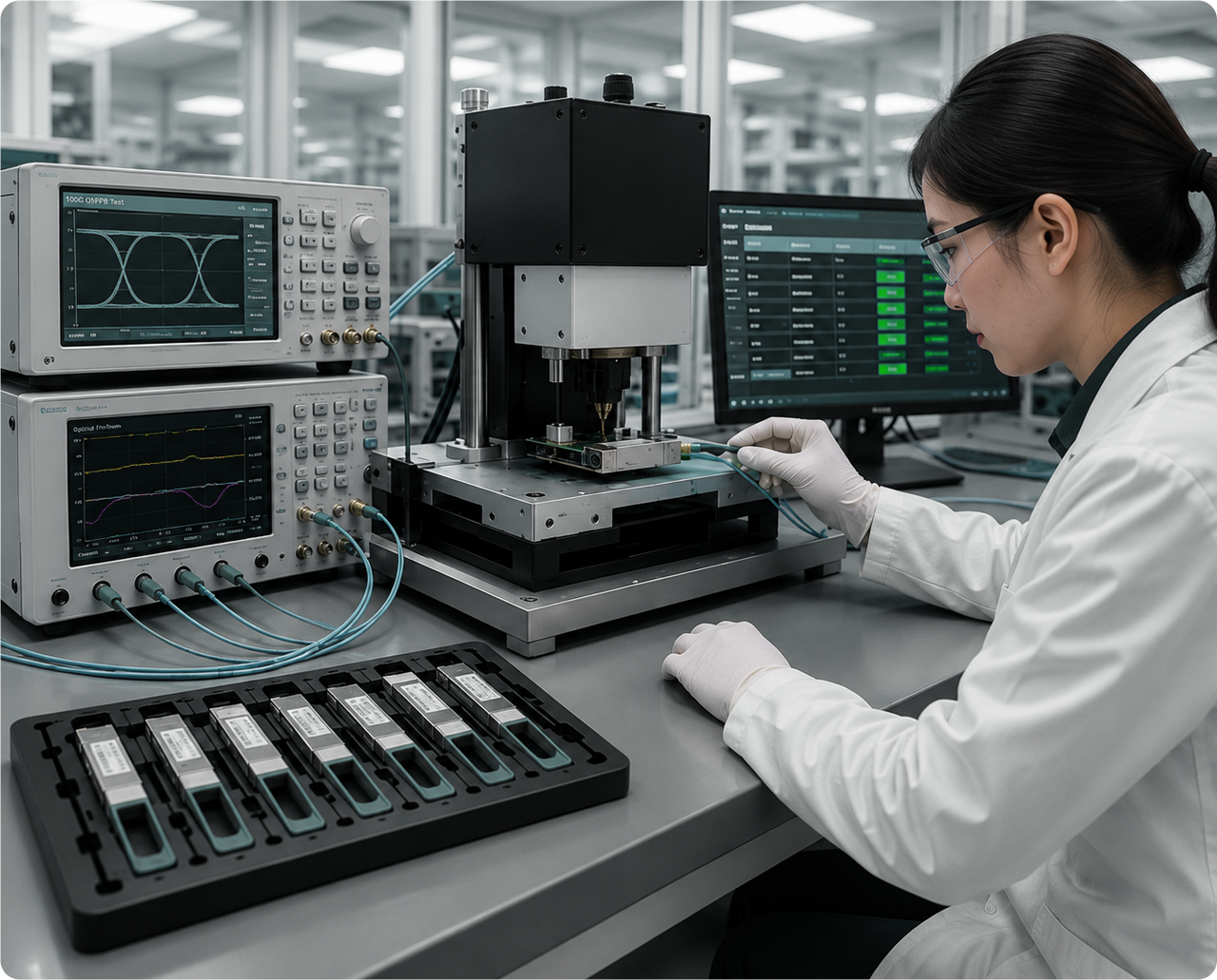
As data centers push toward 1.6T pluggables and co-packaged optics, the optical transceiver has become one of the most thermally sensitive components in the network. TOSA and ROSA sub-assemblies contain DFB, EML, or VCSEL lasers whose wavelength, extinction ratio, and modulation response drift considerably with increases in junction temperature.
This is why AI Cloud computing customers require temperature-cycled qualification at end-of-line (EOL) production testing to verify signal performance across the full case-temperature range before a transceiver can be shipped and installed into data center.
In production, EOL test is the last place a manufacturer can catch a marginal unit, and it is also where throughput pressure is the highest. A test cell can take up to a minute to run a temperature cycle burning line capacity. One test station that stabilizes in seconds, and holds precise temperature can screen more units, tighten the process capability index (Cpk) on optical parameters, and reject early-life failures before they reach a hyperscaler's.
Thermal Requirements for Optical Transceiver EOL Testing
At an optical transceiver manufacturing facility, process engineering knows the line slows down at the thermal head. Every OSFP module must successfully test at cold, ambient, and hot case temperatures before it can ship. A marginal unit in test will take too long to stabilize at each temperature set point and will extend the length of takt time. (Takt time = available production time/customer demand)
A typical EOL test for a OSFP transceiver conducts:
- Cold soak (typically 0 °C at the DUT case) to verify laser wavelength lock and bit error rate at cold turn-on
- Ambient functional test (~25 °C) for baseline optical power, extinction ratio, and TDECQ (how much harder the receiver has to work because the transmitted signal isn’t perfect).
- Hot soak (+70 °C case, sometimes higher for industrial-grade parts) to confirm the module's internal TEC has enough headroom and can hold the eye margin
- Ramp between set points fast enough to keep the station under its takt time, often 5~10 °C/sec or better, matching the ramp rates used in co-packaged optics thermal cycle chambers.
A 800G OSFP dissipates roughly 16W of heat energy and can require more than 50 W of active heat pumping per QSFP transceiver in continuous operation. The EOL thermal head has to pull real power out of a small case while holding temperature stable across a punishing set-point sweep.
Air-only thermal streams do not have high enough heat rejection, generating slower ramp rates and struggle to maintain uniform temperature across multi-DUT fixtures. A liquid-backed recirculating chiller solution is a better fit for high-capacity volume lines.
A Thermoelectric Architecture for Optical Transceiver EOL Testing
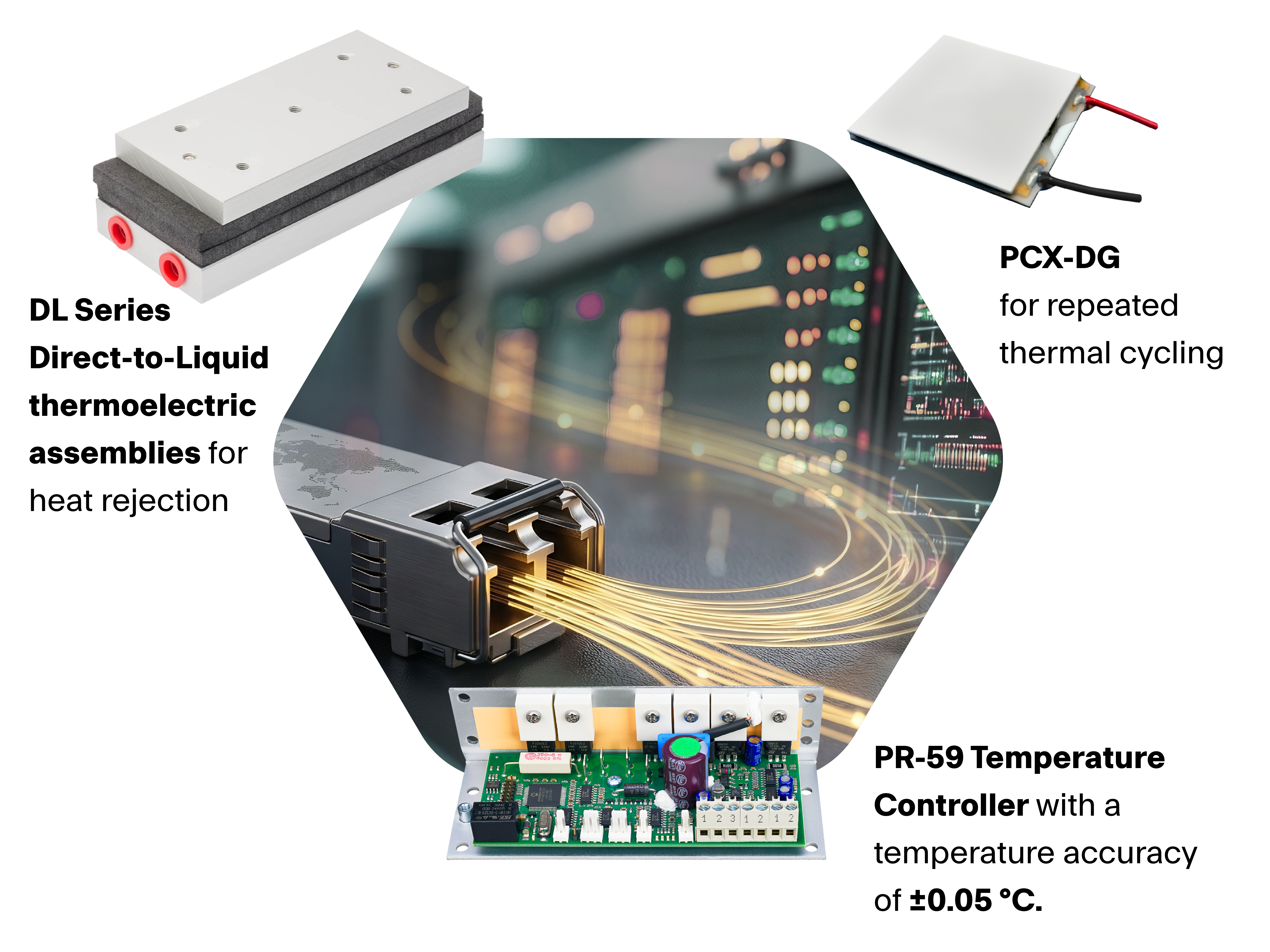
Three Tark Thermal Solutions components can be combined into a compact thermal solution for optical transceiver EOL testing:
- PCX-DG Series thermoelectric coolers for repeated thermal cycling
- DL Series Direct-to-Liquid thermoelectric assemblies for heat rejection
- PR-59 programmable temperature controller for closed-loop temperature control
These components address three critical EOL requirements: fast temperature transitions, precise temperature stability, and high repeated cycling reliability.
PCX-DG Series: Designed for Harsh Thermal Cycling
The PowerCycling PCX-DG Series is engineered for harsh applications that frequently transition between hot and cold temperature set points and require fast temperature ramp rates.
Repeated heating and cooling create mechanical stresses within a thermoelectric cooler. The PCX-DG Series incorporates enhanced thermally conductive soft layers of module construction designed to endure high stresses transferred to thermoelectric elements during aggressive power cycling of high-current-draw thermoelectric coolers.
The DG construction adds thermally conductive soft bonding layers on both the hot and cold side ceramic substrates. This dual-interface construction is designed to absorb more of the punishing mechanical expansion and contraction generated during cycling, reducing mechanical stress as the cooler quickly switches between heating and cooling.
The PCX14-128-F2-4040-TA-RT-W6-DG delivers:
- Up to 116 W cooling capacity at ΔT = 0
- Up to 68.6 °C maximum ΔT
- Performance specified with a 27 °C hot-side temperature
This thermal capacity provides an EOL test head with the headroom required to maintain sub-zero case temperatures while removing active heat from a powered optical transceiver.
DL Series Thermoelectric Assemblies: Managing Hot-Side Heat Rejection
Thermoelectric cooling performance depends on effective hot-side heat rejection. Air-to-liquid or all-liquid loops allow waste heat to be routed away from the test cell, enable multiple stations to use a shared chiller, and help maintain a stable reference temperature for the thermal control system.
The DL-120 -24-00 Direct-to-Liquid thermoelectric assembly provides:
- 135 W cooling capacity
- 24 V operating voltage
- 4.7 A current
- 140 × 60 × 39 mm dimensions
- 0.7 kg weight
The assembly uses water-with-glycol heat exchangers with corrosion-resistant turbulators to maximize heat transfer within the channels. Its compact form factor allows integration into an EOL fixture without consuming significant rack space.
For an EOL cell running four to eight transceivers in parallel, one DL-120 per station (sized to peak simultaneous heat load) gives the PCX-DG head a stable hot-side reference that doesn't drift as the shift wears on.
PR-59: the Closed-loop Brain
None of this works without a temperature controller that can hold set points through the ramp and the soak. The PR-59 programmable temperature controller meets the requirements for EOL station needs and is the workhorse for reversible cooling and heating of TEC assemblies.
- ±0.05 °C temperature accuracy: tight enough to hold TOSA case temperature inside the window where wavelength drift is negligible
- User-selectable PID, ON/OFF, and POWER modes, so a process engineer can tune ramp aggressiveness against overshoot
- 12–30 VDC input, up to 15 A (30 A with additional cooling) provides enough drive for the PCX-DG at full current
- PWM output with H-bridge control for reversible heat/cool, letting the same head drive both cold soak and hot soak without swapping hardware
- RS-232 interface and Windows LT-Interface software for logging, remote set-point control, and integration with the test technician so runtime data can be saved to file for later analysis
- Two programmable fan outputs and an alarm relay round out the controller, so a station can auto-abort if the hot-side loop drops out or if the DUT sensor exceeds a safety limit.
The Tark Thermal Solutions' Triple Play Wins at Optical Transceiver EOL Testing
Speed: The PCX-DG's power density and the DL-120's aggressive heat rejection enables a fast enough station ramp to fit a full cold-ambient-hot station test inside a realistic takt time.
Stability: ±0.05 °C control from the PR-59 means the optical measurements taken at each set point actually reflect DUT performance, not thermal noise in the fixture.
Reliability: The PCX-DG PowerCycling construction is designed for the exact stress profile that creates failures in ordinary TECs on a production line running 24/7.
For high-volume optical transceiver manufacturers, the payoff is measurable:
- higher screening coverage
- tighter Cpk on the parameters hyperscalers care about
- fewer field returns from marginal units that would have slipped through a slower or less accurate EOL station
Learn more about the PCX-DG Series, the DL Series Direct-to-Liquid assembly family, and the PR-59 temperature controller at tark-solutions.com, or contact Tark Thermal Solutions to discuss a custom EOL test-head configuration for your transceiver line.

Related Content


