
Standalone Rack Optical Channel Monitors: Why Thermal Design Makes or Breaks Performance
Key Facts
- Standalone rack OCMs monitor per-channel power, wavelength, spectral shape, OSNR trends, and channel balance in DWDM networks.
- Temperature drift affects AWGs, optical filters, detectors, and reference lasers, reducing measurement accuracy and calibration stability.
- TECs provide localized temperature control to improve wavelength stability, detector noise performance, and long-term repeatability.
- The OptoTEC™ MBX Series from Tark Thermal Solutions supports compact OCM designs, with heat pumping densities up to 43 W/cm², package sizes down to 1.5 x 1.1 mm, and profiles as thin as 0.65 mm.
Introduction
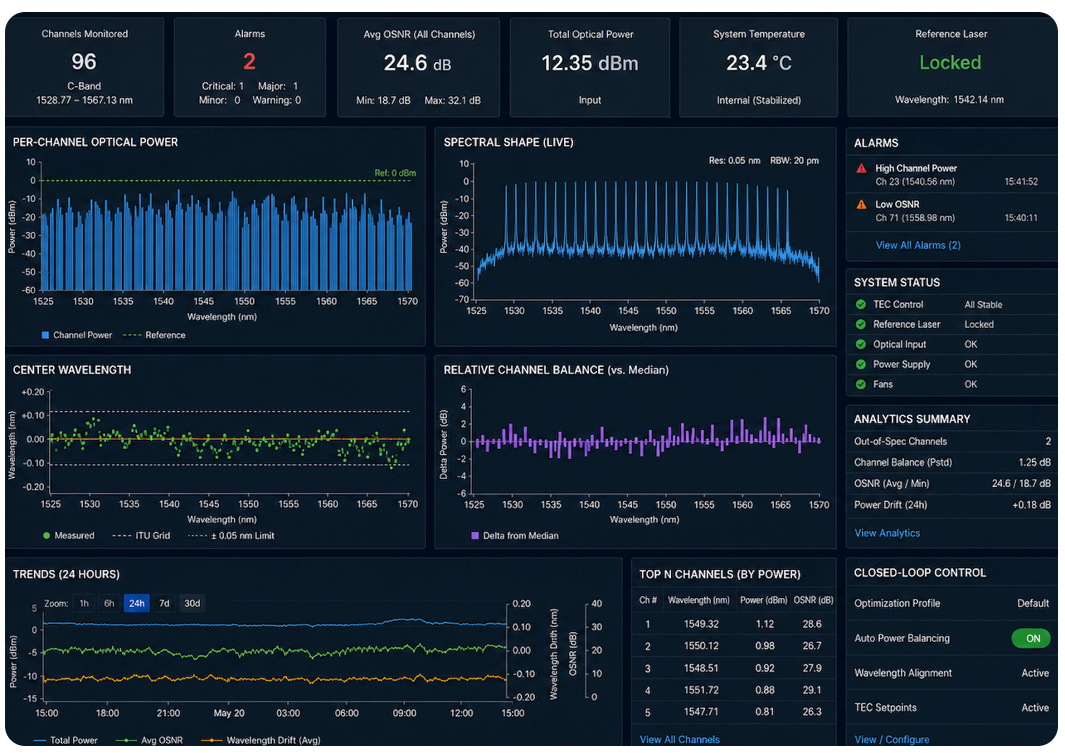
Standalone rack optical channel monitors, or OCMs, are critical measurement systems in Dense Wavelength Division Multiplexing, or DWDM, networks. They provide continuous visibility into the optical spectrum by reporting per channel power, center wavelength, spectral shape, Optical Signal-to-Noise Ratio (OSNR) trends, and relative chann[AD1.1]el balance to higher-level control and analytics systems.
As optical networks scale to higher data rates and more dynamic traffic patterns, OCM accuracy depends on more than optical design. Thermal design is equally important because temperature drift can affect wavelength-selective optics, photodetectors, reference lasers, and calibration stability.
A well-designed thermal management strategy helps rack OCMs deliver reliable measurements across wide ambient temperature ranges, high-density rack environments, and long service lifetimes
What Is a Standalone Rack Optical Channel Monitor?
A standalone rack optical channel monitor is a rack-mounted optical monitoring device used in DWDM networks to measure and report the condition of individual wavelength channels.
It acts as the eyes of the optical layer by feeding channel-level performance data to network monitoring, analytics, alarm, optimization, and closed-loop control systems.
Standalone rack OCMs typically measure:
- Per-channel optical power
- Center wavelength
- Spectral shape
- OSNR trends
- Relative channel balance
This data feeds higher-level monitoring and control systems, helping network operators detect drift, channel imbalance, reduced signal margins, and potential service-impacting issues before they become network failures.
How Rack-Based OCMs Measure DWDM Channels
Most OCMs achieve this by using optical demultiplexers (for example, AWGs or thin‑film filters) to fan out the DWDM spectrum into individual channels or narrow bands. Photodetectors then convert these optical signals to the electrical domain, where digital processing reconstructs the channel metrics. The catch is that both the demultiplexing optics and the detectors are sensitive to temperature, so any thermal drift directly erodes accuracy and repeatability.
Why Temperature Stability Is Critical in Standalone Rack OCMs
Rack-mounted OCMs may operate in indoor network environments, but they still face temperature changes from seasonal variation, daily operating cycles, high-power neighboring equipment, and local rack hot spots. They are also expected to operate for many years with minimal recalibration.
Several OCM components are directly affected by temperature:
- AWGs and optical filters can shift their passbands as temperature changes, distorting apparent channel power and wavelength.
- Reference lasers must maintain wavelength stability to preserve internal calibration accuracy.
- Detectors can experience increased dark current and associated shot noise at higher temperatures, reducing OSNR-related measurement accuracy and low-level power measurement accuracy.
If these components are left at the mercy of rack ambient conditions, the OCM’s measurement baseline will wander, forcing frequent recalibration and undermining confidence in the data.
How Thermoelectric Coolers Improve OCM Accuracy
Thermoelectric coolers, or TECs, stabilize temperature-sensitive optical and detection components by holding them at controlled setpoints. This helps decouple critical components from changing rack ambient conditions.
In standalone rack OCMs, TEC-based thermal control can help:
- Maintain alignment to the ITU wavelength grid
- Stabilize AWG and filter response
- Improve detector noise performance
- Reduce detector dark current
- Improve low-power channel detection
- Support more accurate OSNR-related measurements
- Preserve calibration baselines over time
- Improve measurement repeatability across operating conditions
Fans, heat sinks, and chassis-level airflow remain important for system-level heat removal. However, TECs provide localized, component-level temperature control where measurement accuracy is most sensitive to thermal drift.
Key Thermal Design Issues in Standalone Rack OCMs
While fans, heat sinks, and chassis‑level airflow are still part of the picture, thermoelectric coolers provide fine‑grained temperature control at the component level. Micro TECs can be embedded directly into optical and detection assemblies without major mechanical overhead.
1. Component Selection and Placement
Typical components that merit active thermal control versus passive management include:
- AWGs and wavelength-selective optics
- Detector arrays, especially where low noise is imperative
- On-board reference lasers or other calibration sources
Not every component needs active control. A thermal (passively temperature-compensated) AWGs, for example, are a common passive alternative, and TEC-based stabilization is chosen when wavelength-accuracy requirements exceed what passive compensation can deliver. Where active control is warranted, these components often sit in micro-optical headers or hybrid assemblies that integrate optics and detectors. Their physical placement relative to heat sources, airflow paths, and the chassis walls heavily influences how much cooling power is required and how stable the final setpoint can be.
2. Tight Stabilization
Some OCM functions require tight stabilization around a fixed, moderate setpoint rather than broad cooling capacity. AWGs and reference lasers, for example, must be held at a well-controlled temperature to prevent wavelength drift, channel misalignment, and calibration error as rack ambient conditions change.
The design need is to maintain a stable local thermal environment at the optical component level despite airflow variation, nearby heat sources, and system load changes. Micro TECs help provide this precision temperature control in a compact form factor, but they must be carefully matched to the thermal load, heat-rejection path, control electronics, and available power budget.
3. Power Budget and Heat Pumping Density
Rack power budgets are tight, and OCMs must compete with other line cards and modules for available power. TECs consume power to pump heat, so designers must choose devices that provide enough heat pumping capacity and temperature differential without overstressing the overall power budget. High heat pumping density at relatively low operating current is particularly attractive in high‑port‑count systems where every watt matters.
4. Board Space and Form Factor Constraints
Standalone OCMs often need to fit into standard rack units or compact line‑card footprints. This limits the PCB area and height available for thermal components, forcing designers to think in terms of micro TECs and localized thermal zones rather than large, centralized coolers. Very small footprints, low profiles, and the ability to integrate directly under or next to critical components are key attributes for any TEC being considered.
5. Long‑Term Stability and Calibration Strategy
Thermal design directly affects how often an OCM must be recalibrated in the field. By keeping optics and detectors at consistent temperatures over years of operation, TEC‑based designs help maintain calibration constants and measurement baselines. This reduces field maintenance, simplifies network operations, and makes cross‑site comparisons more reliable.
Using Deep-Cooling TECs for High-Accuracy OCMs
The OptoTEC™ MBX Series from Tark Thermal Solutions is a micro thermoelectric cooler designed for compact optical packages that require deep cooling, high temperature differentials, and strong noise reduction.
The MBX Series is suitable for high-performance standalone rack OCMs because it supports localized temperature control for detectors, wavelength-selective optics, reference lasers, and hybrid optical assemblies.
Key MBX Series characteristics include:
- High heat pumping densities up to 43 W/cm2
- Compact package sizes down to 1.5 x 1.1 mm and profiles as thin as 0.65 mm
- More efficient response to temperature changes
- Cost-effective manufacturing for high-volume production
These features make the MBX Series suitable for compact OCM designs where deep cooling and precise stabilization must be achieved within tight space and power constraints.
Stabilized Optics and Reference Lasers
Many optical and calibration components do not need deep cooling, but they do need tight temperature stabilization.
This includes AWGs, wavelength-selective optics, hybrid assemblies that combine filters and detectors, and on-board reference lasers. By holding these components at a controlled setpoint, MBX TECs help maintain stable wavelength response and calibration accuracy across ambient temperature changes and long service lifetimes.
Why Thermal Management Is a Performance Enabler in Rack OCMs
For next-generation standalone rack OCMs, thermal management is not only a reliability measure. It is a core performance enabler.
A strong thermal design can improve measurement accuracy, reduce drift, support long-term calibration stability, and help network operators trust OCM data for alarms, optimization, and closed-loop control.
Engaging early on TEC selection, placement, and system-level heat rejection helps turn thermal stability into a measurable design advantage.

Related Content
