Cooling Medical X-ray Imaging Equipment
Introduction
Medical X-ray imaging equipment is used to capture internal images of the body for diagnosis, treatment planning and procedural guidance. These systems include CT scanners, C-arm X-ray machines, fluoroscopy equipment and other X-ray-based imaging platforms.
Generating and projecting an X-ray beam is thermally inefficient. Only part of the system energy becomes useful X-ray output, while the remaining energy is released as heat. In medical X-ray systems, heat loads can reach up to 5 kW, and temperature stability is critical for imaging performance, system reliability and equipment uptime.
Liquid cooling systems are often preferred for medical X-ray equipment because they move heat away from the X-ray tube more efficiently than air-based heat transfer methods. This supports higher reliability, reduced field maintenance, greater system uptime and lower total cost of ownership
Application Overview: CT and C-arm X-ray Systems
A medical X-ray system typically includes an X-ray generator, an X-ray tube, a gantry and a recording medium. Inside the X-ray tube, an anode and cathode are housed in a vacuum tube. The cathode is usually a heated filament, while the anode is commonly made from tungsten.
CT Scanners
In computed tomography, or CT, the X-ray tube and detector rotate around the patient during the examination. The scanner collects many images and reconstructs them layer by layer to create a three-dimensional view.
CT systems require stable cooling because the tube, detector and gantry electronics operate under demanding thermal and mechanical conditions.
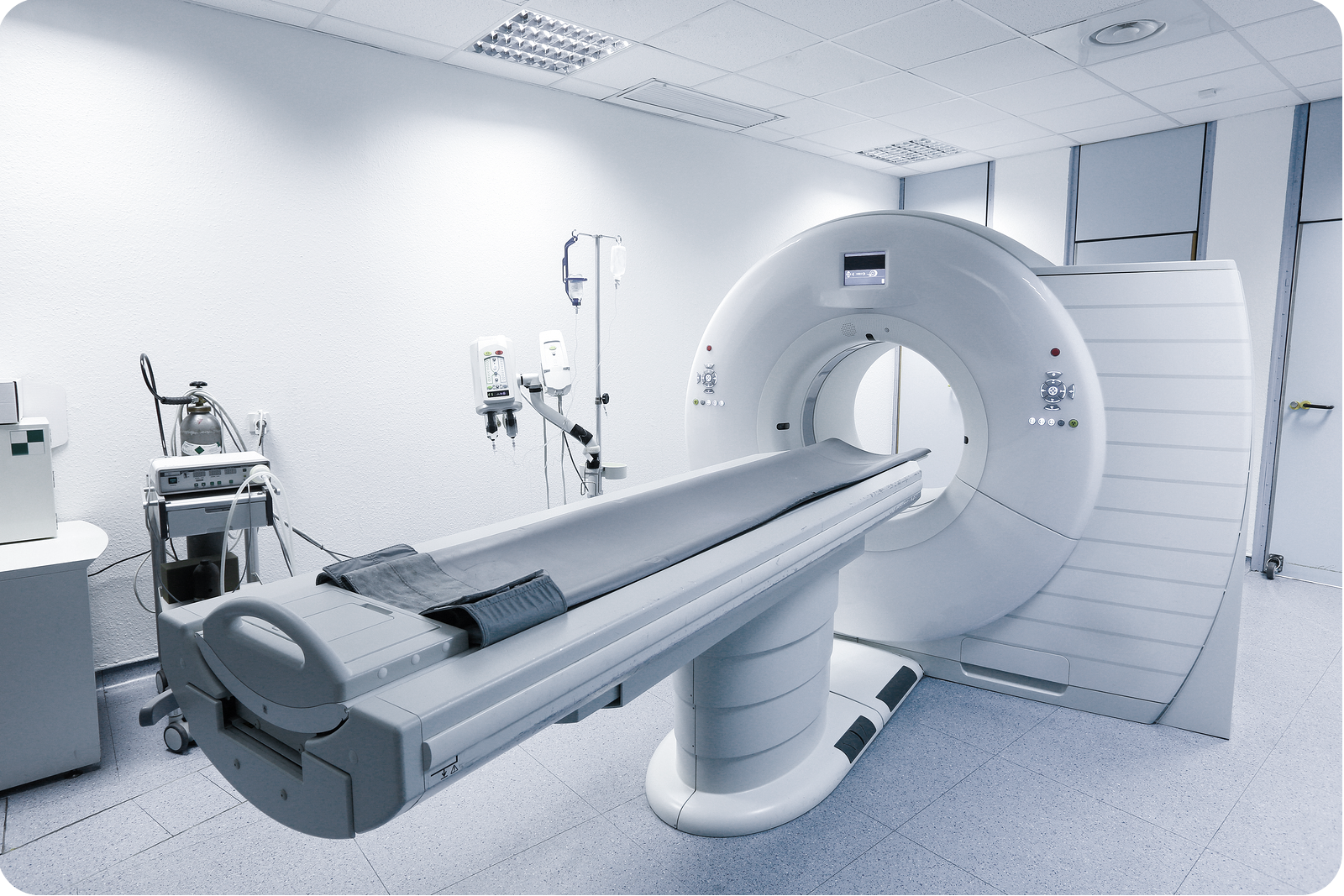
In CT scanners, both the tube and detector rotate around the body during X-ray examination.
C-arm X-ray Systems
C-arm X-ray machines create continuous, real-time images of body parts, instruments or contrast agents. They are often used during surgical, orthopedic, and emergency care procedures.
Compared with CT scanners, C-arm systems require less space in the operating room. Their compact form factor creates additional thermal design challenges because components must fit into tighter enclosures while maintaining image quality and reliability.
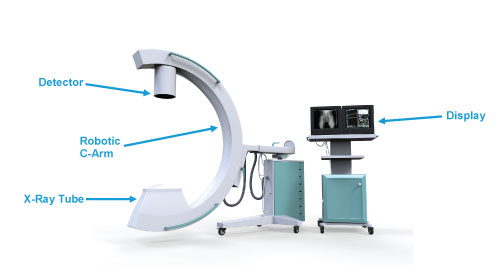
Key components of a C-arm X-ray Machine
Thermal Challenges in Medical X-ray Imaging
High Heat Loads from X-ray Generation
X-ray systems can generate heat loads from 1 kW to 5 kW that must be removed efficiently. The X-ray tube, especially the anode, must be cooled to support optimized X-ray performance and long operating life.
Detector Temperature Stability
The detector typically requires a lower heat-load cooling system, usually below 300 W. Precise detector temperature control helps enhance image resolution and reduce thermal noise.
Smaller Systems and Higher Power Density
Medical X-ray manufacturers are designing systems with faster scan speeds, improved image quality, smaller form factors and higher power density. As a result, simple thermal approaches such as adding a fan or heat sink often cannot meet performance and reliability requirements.
Low Noise Requirements
Cooling systems must operate quietly because noise can disturb patients and clinical staff during imaging procedures. Liquid cooling supports quieter operation than many air-based cooling approaches.
High G-force Gantry Conditions
Medical X-ray systems often use rotating gantries that contain temperature-sensitive components. During imaging, these gantries spin rapidly and expose internal electronics and cooling components to high rotational speeds and acceleration forces.
Liquid cooling pumps must maintain pressure and constant coolant flow under these high G-force conditions. Pump reliability is especially important because pump failure can stop the cooling system and cause equipment downtime.
Why Liquid Cooling Is Used in Medical X-ray Equipment
liquid cooling systems are self-contained units that recirculate coolant to a predefined set-point temperature. Liquid cooling systems are able to dissipate a large amount of heat generated by the medical X-ray system.
Compared with conventional air-cooled systems, liquid cooling offers:
| Benefit | Impact on Medical X-ray Equipment |
|---|---|
| Higher heat-pumping capacity | Removes bulk heat from X-ray tubes and high-power components |
| Better heat routing | Moves heat away from thermally sensitive areas inside the gantry |
| Faster cooldown | Helps support scan speed and uptime |
| Quieter operation | Reduces acoustic disturbance during imaging |
| Higher reliability | Supports long equipment life and lower maintenance |
Tark Thermal Solutions liquid cooling systems provide higher efficiency than air-based heat exchangers and can deliver cooling up to 5X higher per square area than conventional air heat transfer methods.
Liquid Cooling System Configurations
Depending on the medical scanner, two different types of liquid cooling systems can be utilized:
- Liquid-to-air heat transfer configuration: a high-pressure pump recirculates the liquid coolant, while an air heat exchanger removes the heat from the liquid circuit, dissipating it into the ambient environment by means of a fan. The coolant can be water, a water-glycol mixture, or transformer oil, depending on the temperature at the heat source; an oil-cooled system is used when the temperature exceeds the operational temperature limit of the water-based systems.
- Liquid-to-liquid configuration: a pump recirculates the coolant and ambient-temperature water is used in a liquid heat exchanger to dissipate heat on the hot side. The liquid-to-liquid system increases cooling capacity compared with the liquid-to-air system. These systems can be designed to operate with either water or oil as the coolant liquid, depending on the temperature environment.
Types of X-ray tubes and Coolant Selection
Medical X-ray systems may utilize two different types of X-ray tubes that impacts the type of coolant used in the liquid cooling system.
| X-ray Tube Type | Cooling Requirement | Typical Coolant |
|---|---|---|
| Bipolar X-ray tube | Cooling fluid around the anode contacts electrical potential and must not conduct electricity | Oil or another nonconductive coolant |
| Monopole X-ray tube | Anode side is grounded, so there is no electrical potential at the coolant interface | Water-based coolant, typically water-glycol |
For all types of liquid cooling systems, additional features can add precise temperature control, variable coolant flow rate, coolants with corrosion inhibitors and coolant filtration, as needed. Temperature control of multiple liquid circuits is often required, as is high operational temperature. As with most gantry systems, control of multiple pressure drop settings to accommodate both low and high-pressure conditions may be needed.
For advanced systems, coolant circuits may also include corrosion inhibitors, filtration, variable coolant flow, multiple liquid circuits and multiple pressure drop settings.
System Flow Diagram
Liquid cooling systems are able to dissipate a large amount of heat generated by the X-ray system. A liquid heat exchanger system cools the coolant in a liquid circuit by the use of a liquid-to-air heat exchanger. The system contains of a pump that circulates coolant and a liquid circuit to transfer coolant from the heat source to the liquid cooling system. The expansion device enables the cooling circuit to be completely sealed from the outside environment and compensates for the thermal expansion of the fluid over its wide operating temperature range.
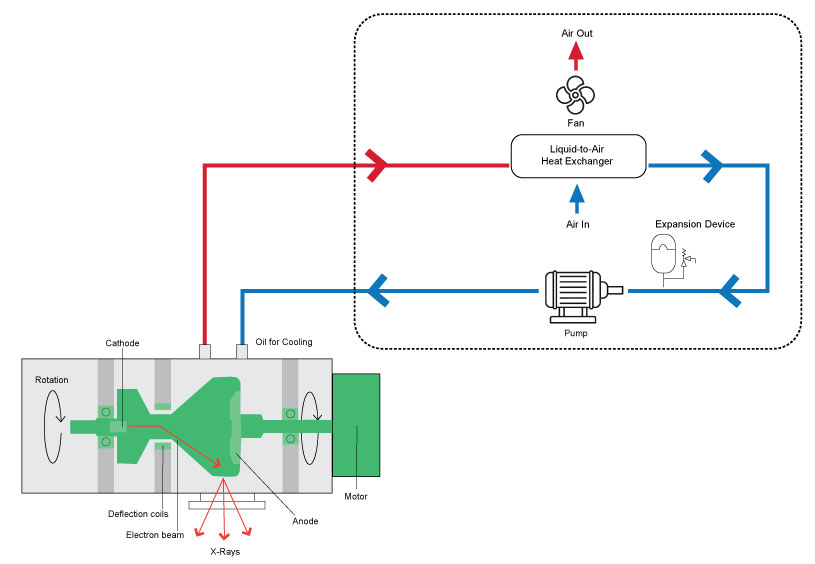
Liquid flow in a typical cooling system for medical X-ray equipment
Custom Liquid Cooling Solutions from Tark Thermal Solutions
Medical X-ray equipment often requires a custom liquid cooling configuration because each system has unique heat loads, space constraints, coolant requirements, pressure conditions and reliability targets.
Liquid cooling systems offer a high coefficient of performance (COP) that delivers efficient, low power operation to maximize uptime and optimize performance of medical X-ray imaging equipment. This efficiency optimizes heat transfer delivery away from thermally sensitive components to the ambient environment.
A liquid cooling system offers higher efficiency than air-based heat exchangers and provides more rapid cooling, quieter operation, higher reliability, and increased system uptime. Compared to conventional air heat transfer mechanisms, liquid cooling systems offer cooling up to 5X higher per square area. Tark Thermal Solutions’ liquid cooling systems feature high thermal conductivity of coolants to remove bulk heat in Kilowatts with rapid cool down.
Tark Thermal Solutions designs custom liquid cooling systems for water, water-glycol, dielectric oil and coolants with corrosion inhibitors. These systems can support multiple liquid circuits, multiple pressure drop settings, high operating temperatures and precise temperature control.
Engineering services include onsite concept generation, thermal modeling, mechanical design, electrical design, rapid prototyping and validation testing for medical industry compliance requirements.
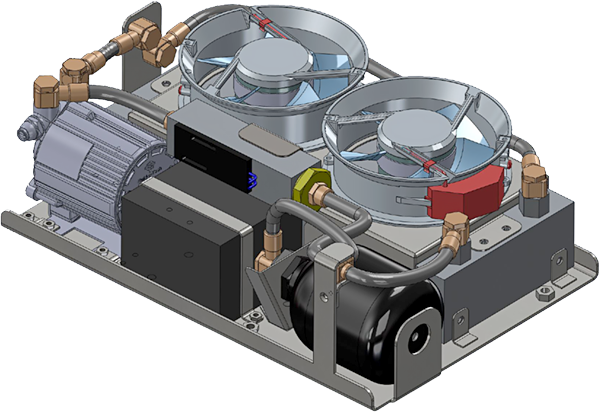
Because medical X-ray equipment features many unique cooling challenges, a custom liquid cooling system may be the optimal solution.
Liquid Cooling System Pump
Tark Thermal Solutions has developed a spindle screw pumps featuring a simple construction that is ideal for high vibration, high G-force applications like rotational medical X-ray equipment. Compared to centrifugal pumps, spindle screw pumps provide higher reliability, performance and efficiency for liquid cooling systems. The fluid delivered by a screw pump does not rotate radially, but moves linearly. The rotors work like endless pistons, which continuously move forward. Flow through a screw pump is axial and in the direction of the power rotor. The inlet hydraulic coolant that surrounds the spindles is trapped as the spindles rotate. The coolant is pushed uniformly with the rotation of the spindles along the axis and is forced out the other end. This results in reduced power consumption, higher efficiency and a smaller motor size. It also enables the spindle screw pump to move fluids of higher viscosity without losing flow rate, and pressure changes have little impact on spindle screw pumps. Vital to the performance of rotating applications like a CT scanner gantry system, screw pumps are able to maintain constant flow and pressure while under high stress caused by high g-forces.
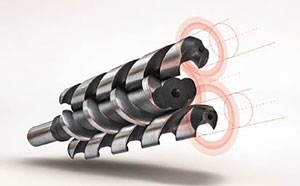
Long life operation is built into the spindle screw design due to no metal-to-metal contact between moving components. This minimizes friction wear and abrasions that can cause cavitation. The flexible mechanical assembly allows the use of a smaller strainer with higher mesh size that extends maintenance intervals and reduces the overall cost of ownership. No metal-to-metal contact also results in the elimination of pulsations, even at high flow rates, making the unit very quiet during operation. The end result is smooth and quiet operation even at high revolution rates and pressure.
More information on Tark Thermal Solution’s spindle screw pump technology can be found at https://tark-solutions.com/thermal-technical-library/application-notes/spindle-screw-pump-technology-medical-cooling
Design Considerations for Medical X-ray Cooling
| Design Factor | Engineering Consideration |
|---|---|
| Heat load | X-ray tubes may require 1–5 kW heat removal; detectors usually require precise cooling below 300 W |
| Cooling architecture | Liquid-to-air or liquid-to-liquid configuration depends on capacity, environment and packaging |
| Coolant type | Water, water-glycol, dielectric oil or corrosion-inhibited coolant may be required |
| Tube type | Bipolar tubes often require nonconductive coolant; monopole tubes can use water-glycol |
| Gantry mechanics | Pumps must maintain flow and pressure under rotation, vibration and high G-force stress |
| Noise | Cooling must remain quiet for patient and clinical environments |
| Footprint | Compact equipment requires high cooling capacity in reduced space |
| Reliability | Long uptime and reduced maintenance are critical in medical imaging environments |
Conclusion
Medical X-ray imaging equipment requires advanced thermal management because X-ray generation produces significant waste heat. X-ray systems can generate 1–5 kW of heat, while detectors typically require precise low-load cooling below 300 W to enhance image resolution.
Custom liquid cooling systems from Tark Thermal Solutions support bulk heat removal, precise temperature control, quiet operation and compact integration. For rotating gantry systems, Tark Thermal Solutions spindle screw pump technology helps maintain constant coolant flow and pressure under high G-force conditions while supporting long-life, low-noise operation.